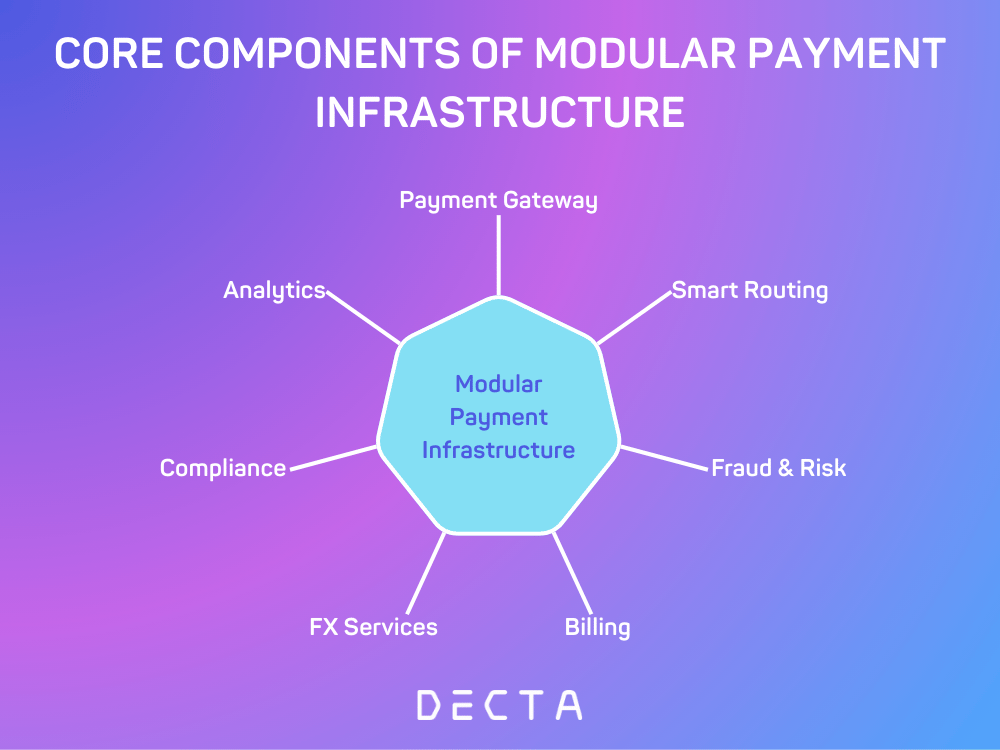
Key Components of a Modular Payment Infrastructure
Once modular fits your business, here is what the stack is typically built from. Each component below works the same way whether it is bundled or standalone; what changes in a modular setup is that you can choose it, swap it, or run two side by side.
Core Payment Gateway
As its own module, you choose which payment gateway to run, independent of your acquiring or fraud provider. Open APIs let you connect to multiple providers rather than being locked into whichever gateway came bundled with your processor. That keeps your checkout experience consistent even as you add markets or swap the gateway behind it.
Smart Routing and Orchestration Engines
Routing engines optimise the payment path by selecting the most reliable or cost-effective provider in real time. Approval rates can improve significantly, especially when paired with network tokens instead of PANs, reducing fraud exposure.
Orchestration engines extend this efficiency further by triggering fraud checks, compliance screenings, or reconciliations automatically, removing manual interruptions.
Centralising both routing and orchestration gives you stronger control over transaction flows, fewer failed payments, and lower operational costs.
Fraud & Risk Management Modules
As a modular setup, you can combine multiple fraud detection methods, device fingerprinting, behavioural analysis, velocity checks, tokenisation, rather than relying on one tool. As new fraud patterns emerge, you can update or swap a single tool without overhauling the whole system. See the Fraud Risk Controls section of the payment infrastructure guide for how each method works.
Billing & Invoicing Tools
As a standalone module, billing can match your pricing model, fixed, tiered, or usage-based, and plug into your accounting software for tax calculation and reconciliation without being tied to the rest of the payment stack.
Currency Conversion & FX Services
Because FX runs as its own module, it can be swapped or extended market by market without disrupting the rest of your payment flow, while still connecting to your gateway and routing engine for accurate checkout pricing and settlement.
KYC, AML & Compliance Plugins
As modular plugins, KYC and AML tools can be updated independently whenever a market's regulatory requirements change, without touching the rest of the stack. See the AML/CFT And KYC section of the payment infrastructure guide for what each check covers.
Analytics & Reporting Dashboards
As a separate module, your dashboard can pull data from every other component into one view, tracking authorisation rates and bottlenecks by geography, payment method, or provider, feeding back into routing and fraud decisions without being locked to one provider's reporting tool.