How Does Real-Time Payment Infrastructure Work?

This article explores the mechanics of instant payment infrastructure and its growing role in modern business operations, building on the wider payment infrastructure that carries every transaction. It breaks down the core systems that enable instant transactions, outlines the benefits for cash flow and competitiveness, and examines the technical and regulatory challenges of adoption.

September 30, 2025
Real-Time Payment Infrastructure

The shift toward real-time payments reflects a broader transformation in financial services driven by customer expectations, regulatory initiatives, and technological advancements. As businesses face rising pressure to provide immediate access to funds, instant confirmation, and always-on availability, the traditional batch-based settlement model is quickly losing relevance.

This article provides a structured look at how real-time payment systems function, why they matter for operational efficiency and competitiveness, and what organisations must consider when implementing them in practice.

What Is Instant Payment Infrastructure?

Real-time payment infrastructure is the digital architecture that enables the movement of money between accounts instantaneously. Unlike a typical transfer that requires batch processing to reconcile and takes up to a full day, real-time payments mean settlement confirmation is instant and executed on demand.

A side-by-side infographic comparing traditional batch payment processing, which takes days and is limited to banking hours, with real-time payment infrastructure that enables instant, always-on transfers and immediate settlement.

Network availability is 24x7x365, meaning you need not worry about accessing your bank during open hours or having a holiday impede your transaction. This always-on accessibility provides immediate access to funds, which reduces risk for the individual payor and the business receiver.

At its most basic level, instant payment infrastructure is comprised of:

  • Payment networks that facilitate transfer between banks/financial institutions.
  • Messaging standards (ISO 20022) that detail the transaction.
  • Clearing and settlement solutions that adhere to best practices so funds are moved almost instantaneously.

The Core Components That Make It Work

Real-time payment systems rely upon a myriad of standards, security protocols and payment and financial institution interactions. Each component ensures instant movement of money with clear messaging to and from parties involved, so settlement is finalised and cannot be reversed.

Essential Infrastructure Elements

Payment networks serve as the most critical component, and no single network has a monopoly on real-time payments:

  • EU: TIPS (the Eurosystem's settlement service) and RT1 (operated by EBA Clearing) carry SEPA Instant Credit Transfers.
  • UK: Faster Payments performs the same role.
  • US: both RTP (The Clearing House) and FedNow (the Federal Reserve) connect banks and processors for instant transfers.

These networks connect banks and processors alike, so you can send or receive money without concern or delay.

Messaging standards are equally important. Most use ISO 20022 MX messages, which means there are structured data references for credit transfers from sender to recipient, payment confirmations back, and status updates along the way. Such formatting allows for interoperability between different financial institutions offering payment rails.

APIs control access. Banks and fintech offerings utilise RESTful or ISO-compliant 20022 APIs to connect with payment rails so you can dynamically receive and send real-time payments through your treasury management systems, mobile solutions or merchant platforms with reliable automation.

Settlement occurs in either central bank ledgers or private clearing engines. In the EU, TIPS settles in central bank money while RT1 settles in commercial bank money; in the US, FedNow settles transactions directly on Federal Reserve accounts while RTP uses a pre-funded model.

Either approach provides immediate settlement finality, which reduces risk compared with deferred or batch processing, since there is no waiting period or uncertain resolution time.

Component
Payment Networks
Messaging Standards
APIs
Settlement Models
Function
Connect banks and processors for instant transfers
Provide structured data for transfers, confirmations, and updates
Enable access and integration for banks, fintechs, and merchant systems
Ensure immediate settlement finality with no delay
Example / Standard
FedNow (Federal Reserve), RTP (The Clearing House)
ISO 20022 MX messages
RESTful APIs, ISO 20022 APIs
Central bank ledger (FedNow), Pre-funded model (RTP)

How the Process Actually Works

There is a defined payment flow:

  • Initiation - You request a payment (who it's from, who it's going to, and the amount).
  • Messaging - The request is sent over the network using ISO 20022 for structured transfer.
  • Clearing - The system checks that the account is real and that the funds are available, and runs the usual compliance checks.
  • Settlement - Each payment is settled individually and immediately, rather than being collected into a batch with other transactions.
  • Confirmation - Both sides immediately acknowledged that payment is complete.

Unlike batching systems, real-time payments operate with 24/7/365 availability. Each transaction is final based on settlement, meaning you instantly have access to funds when money comes your way. Some networks are also exploring stablecoin settlement, applying this same initiation-to-confirmation structure to blockchain-based currencies.

Real-Time Payment Rails By Region

Real-time payment rails are not a single global system. Each region has built its own instant rail on top of its existing payment networks, and adoption has moved at different speeds depending on regulation and market demand.

European Union

The EU's instant rail is SEPA Instant (SCT Inst), running alongside the regular SEPA Credit Transfer, which still takes one business day. TIPS, the Eurosystem's settlement service, and RT1, operated by EBA Clearing, both carry SCT Inst payments around the clock.

Under the EU Instant Payments Regulation (Regulation (EU) 2024/886), euro-area payment service providers had to be able to receive instant credit transfers from 9 January 2025 and to send them from 9 October 2025, at no higher price than a standard transfer.

Verification of Payee, which checks that the name on an account matches the payee before a transfer is authorised, became mandatory on the same October 2025 date.

The former EPC scheme-level cap of €100,000 per transaction no longer applies; the 2025 SCT Instant Rulebook sets no maximum amount at scheme level, though individual providers may still set their own limits.

United Kingdom

The UK's instant rail is Faster Payments, which has settled transfers in seconds since 2008 and sits behind most UK banking apps.

Open Banking APIs and Variable Recurring Payments (VRP) sit on top of Faster Payments, letting a third-party provider move money directly from a customer's account with their consent, for one-off or recurring payments.

Since 7 October 2024, the Payment Systems Regulator's mandatory reimbursement rules require the sending bank to refund victims of authorised push payment fraud on Faster Payments up to £85,000 per claim, with the receiving bank covering half the cost.

The rule gives UK banks a direct financial reason to screen instant payments as closely as they screen card transactions.

United States

The US runs two real-time networks side by side. RTP, operated by The Clearing House, launched in 2017 and reaches most of the country's larger banks.

FedNow, run by the Federal Reserve, launched in 2023 and was built specifically to extend real-time access to smaller banks and credit unions that RTP had not reached.

Regular ACH transfers, still the default for payroll and billing, take one to two business days by comparison.

Rest of the World

Outside Europe, the UK and the US, India's Unified Payments Interface (UPI) and Brazil's Pix are the two largest instant payment systems by volume, both settling transfers in real time and both built and mandated by national regulators rather than card networks.

Across every region, the underlying benefit is the same: once a real-time payment is confirmed, it is irrevocable and the funds are usable immediately, which is why fraud controls have to happen before the money moves rather than after.

Key Benefits for Your Business

Real-time payment systems dramatically improve access to money and significantly cut unnecessary expenses. They also enable businesses to meet customer demands, improve efficacy and proactively champion changes before other organisations implement them.

Immediate Business Impact

Payments you receive immediately give you access to funds instantly without waiting for industry-standard clearing times. This means an improved working capital situation because payroll or reinvestment opportunities are met sooner rather than later, because once a transaction hits, it's yours without hassle.

Key impacts include:

  • Lower transaction costs: Pricing varies by provider and region, but the direction is consistent. In the EU, regulation now requires that an instant transfer costs no more than a standard transfer from the same provider, and instant rails generally undercut same-day ACH or wire fees elsewhere too.
  • Reduced reliance on credit: Real-time settlement means you no longer need to draw on a credit line to cover the gap while a payment clears. Funds arrive immediately, which cuts interest costs and makes cash management decisions easier.
  • Automated posting and confirmations: These avoid manual revisions and delays through batch systems, which are often erroneous in their reconciliation checks. It means fewer issues reconciling each month and less time wasted trying to double-check numbers that don't match up on different timelines.

Competitive Advantages

Adopting real-time payments early helps you keep pace with evolving customer expectations. Clients who have grown accustomed to instant confirmations now expect instant transactions, and offering that builds trust.

The technology also opens new revenue opportunities: instant payouts for gig workers, refunds and supplier settlements are easier to offer, and some partners will choose you over a competitor because of it.

Because real-time rails run 24/7, you are not limited by bank hours for international operations or online sales, which is a real edge in fast-moving markets.

Power Instant Payment Processing

DECTA's real-time processing lets you settle payments instantly, day or night, without waiting on batch cycles.

Explore Real-Time Processing

Common Implementation Challenges

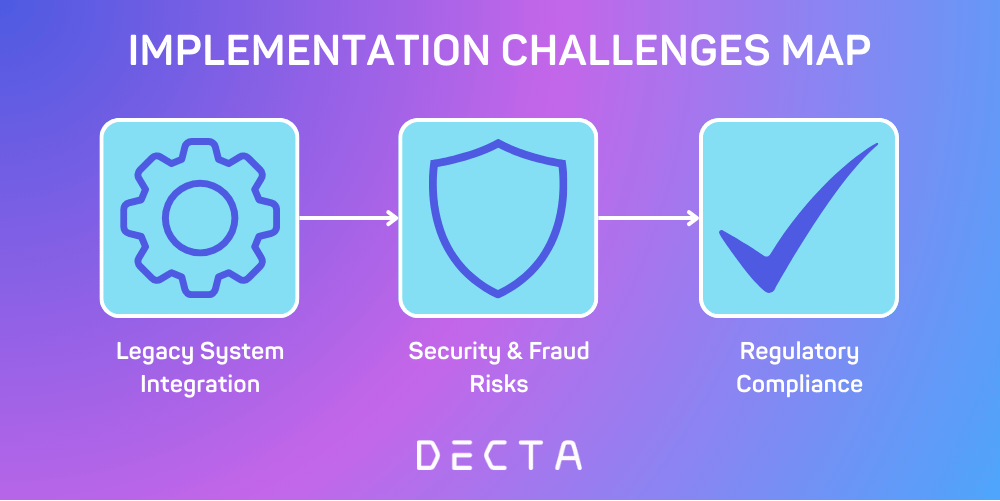
Implementing a real-time payment system is more than just thinking quickly; there are many complex challenges surrounding old standards integration, rapid fraud movements and the regulatory changes that exist across regions, which require specialised attention.

A visual map illustrating the three main challenges of implementing real-time payment systems—legacy IT integration, heightened fraud risks, and differing regulatory compliance requirements across regions.

Legacy system integration

Many financial institutions still operate on older systems. Many of these systems have been in play for decades; they were never designed for instant settlements, so upgrades are expensive and time-consuming.

Moving legacy systems over to ISO 20022 standards, for example, takes over a year for vast financial institutions.

You're at risk not only for integrated systems working with new core systems but for supporting interfaces too - reporting and reconciliation engines all need periodic testing to ensure continuity.

Upgrades can cause downtime, and any errors that reach customers hurt trust quickly.

Some organisations take a phased approach instead, running the old and new systems in parallel until the new one catches up. This avoids major interruptions, though it adds short-term complexity. For a closer look at reducing that risk, see payment infrastructure migration.

Security and fraud risks

Because an instant payment cannot be reversed once it settles, every check has to happen before the money leaves the account, not after. This is the opposite of how card payments and batch transfers work, where a chargeback or recall is still possible for days.

The main threat is authorised push payment fraud, where a scammer tricks the account holder into approving a payment themselves rather than stealing their credentials.

Because the payment is genuinely authorised, standard fraud rules do not catch it; only name-matching checks like Verification of Payee in the EU and Confirmation of Payee in the UK, which confirm that the account name matches the payee before the transfer is sent, are effective against it.

Sanctions and anti-money laundering (AML) screening also have to run in real time, 24/7, against the relevant lists for each region: OFAC in the US, EU financial sanctions lists, and the UK's OFSI list.

There is no overnight batch window left to catch a flagged payment after the fact.

Machine learning models help by flagging transactions that break a customer's normal pattern, such as a payment sent to a new payee for an unusually large amount.

The challenge is keeping false positives low: a legitimate payment that gets blocked or delayed undermines the instant experience the customer is paying for.

Regulatory compliance requirements

Each region enforces real-time payments through its own rules, and the requirements are becoming more specific rather than less.

In the EU, the Instant Payments Regulation (Regulation (EU) 2024/886) obliges euro-area providers to receive instant transfers, send them, and run Verification of Payee, all at no extra cost to the customer compared with a standard transfer.

Strong Customer Authentication continues to apply to instant payments alongside these newer obligations; see the DECTA payment infrastructure guide for a full explanation of Strong Customer Authentication.

In the UK, the Payment Systems Regulator's mandatory reimbursement rules put the cost of authorised push payment fraud directly on the sending and receiving banks, which is a strong incentive to invest in Confirmation of Payee and other pre-transfer checks rather than absorb losses after the fact.

In the US, the Bank Secrecy Act requires continuous transaction monitoring and reporting, which applies to real-time payments in the same way it applies to any other transfer.

Build Your Payment Infrastructure

DECTA designs, builds, and operates the processing, gateway, and issuing infrastructure behind your payment business.

Talk to DECTA