Learn how to open a merchant account step by step, from assessing your payment needs and comparing providers to submitting documents and setting up payment processing. A practical guide for business owners who want to accept secure, reliable card payments.
May 06, 2025
Opening a merchant account may seem complicated, but by following a structured, step-by-step process, you can make it simple. Whether you're running an online store, a brick-and-mortar shop, or a combination of both, having a merchant account enables secure and reliable transactions.
What is a Merchant Account?
A merchant account is a specialised business bank account that holds funds from customer card transactions before transferring them to a business's primary bank account. Merchant account providers can be banks or other financial institutions.
An acquiring bank acts as the intermediary between customers and your business by ensuring the correct funds are available and the transaction is authorised.
The acquiring bank, or acquirer, is the institution that holds your merchant account and connects it to card schemes such as Visa and Mastercard, so choosing a payment acquiring provider is the core decision when you open a merchant account.
This process occurs whenever a customer wishes to buy something - they will enter their card details on the checkout page or via a point of sale (POS).
Once a payment is authorised, the acquirer settles the funds into your merchant account and pays them out to your business bank account on an agreed settlement schedule, which determines how quickly card revenue reaches your cash flow.
Who Needs a Merchant Account?
Any business looking to accept electronic payments, including credit and debit card payments, will need a merchant account.
Here are a few businesses that can benefit from merchant accounts:
eCommerce Businesses: Accepting payments from customers who purchase on websites is essential for online retailers.
Retail Stores: To accept payments from customers who make purchases in-store at a POS.
Restaurants: Merchant accounts will allow restaurants to accept credit and debit cards from customers dining in or ordering. Orders can be in person, online, or via mobile payments through food delivery apps.
Service Providers: To accept payments from clients who pay for services using credit or debit cards, e.g. childcare services.
Healthcare Providers: Merchant accounts allow healthcare providers, e.g. doctors or dentists, to process payments from patients to pay for medical services using their debit or credit card.
Non-Profit Organisations: To accept donations from supporters, both from those who make contributions in person and online.
Step 1: Assess Your Business Needs
The first step, before choosing a payment processor, is to assess the needs of your business. Here are a few things to consider:
Where Will You Accept Payments?
You may be a business that just needs to accept payments online or at a brick-and-mortar store, or you may need an omnichannel payment processing solution that combines online and in-store payments in a single setup, so sales and reporting from every channel flow through one merchant account.
In-Person Payments
If you run a physical establishment where customers interact face-to-face with employees, also known as a brick-and-mortar store, then a point of sale (POS) terminal is best suited.
The terminal will allow your business to process payments quickly by syncing the register with your merchant software.
Online Payments
If your business conducts commercial activities on an online platform or over the internet, e.g. an online or eCommerce business, then you'll require an online payment gateway.
A payment gateway is the technology that securely passes card details from your website or app checkout to the acquirer for authorisation, linking your checkout to your merchant account.
This method will enable customers to securely purchase your products and services over the web or directly through bank accounts via your merchant account provider.
Mobile Payments
For a business that requires a mobile setup, a mobile payment processing solution is essential.
Modern card readers are wireless and attach to iOS and Android systems to seamlessly process payments remotely.
You could also consider accepting digital wallet payments like Google Pay, PayPal, or Apple Pay.
Over-the-Phone Payments
If your business operates over the phone, then you could benefit from a virtual payment terminal.
This method allows you to enter the customer's card details manually into your system, turning your computer into a payment card terminal.
These card-not-present transactions are known as MOTO (mail order/telephone order) payments, and providers usually need to enable MOTO on your merchant account before you can accept them.
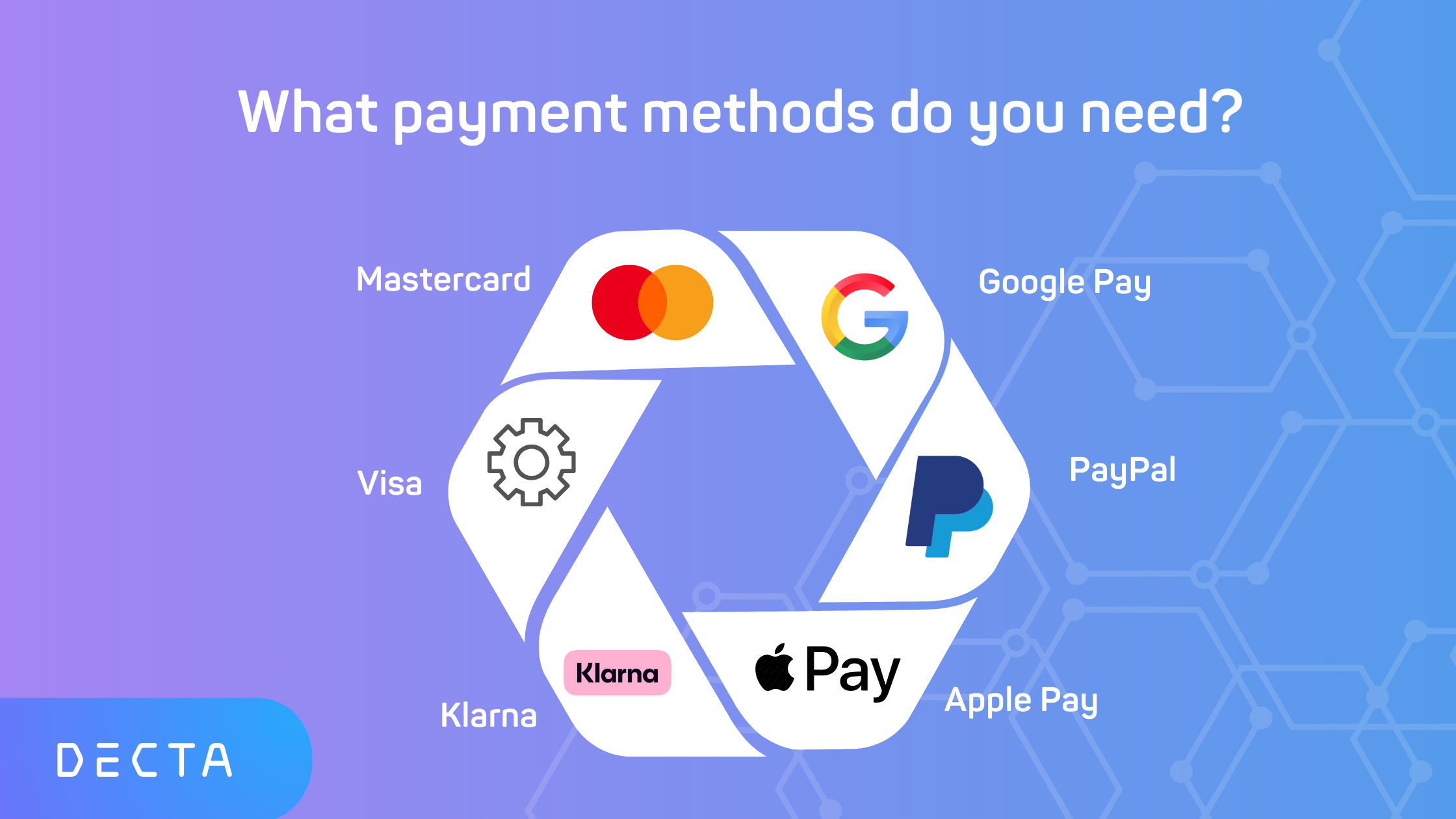
What Payment Methods Do You Need?
It's important to meet your customers' payment expectations and preferences by accepting payment methods they know and trust, including electronic payments, online transactions and credit card payments.
Here are a few payment methods to consider:
Mastercard: a leading payment network and a preferred payment method among merchants and consumers worldwide.
Visa: recognised and trusted by banks and consumers globally, facilitating online transactions.
Klarna: a global payments provider which offers Buy Now, Pay Later and other financing options, enabling a more convenient checkout for your customers.
Apple Pay: ensures simple and secure payments via a digital wallet, supporting both international and local payments.
PayPal: a widely used digital wallet, offering businesses and consumers a secure way to send and receive payments.
Google Pay: allows users to connect payment cards to their Google accounts, used by millions of consumers worldwide.
Expected Transaction Volume
Some merchant account providers are better equipped at processing high transaction volumes.
eCommerce platforms and subscription services are likely to experience significant transaction volumes.
High-volume merchant account providers offer the essential infrastructure to handle large transaction volumes securely.
Which Currencies Will You Accept?
If you sell to customers in other countries, check which currencies a provider can process and settle in. Accepting payments in your customers' local currency makes checkout more familiar and helps you expand into new markets.
Security & Compliance Needs
Merchant account providers offer the infrastructure to keep up with evolving regulatory requirements, adapting to emerging threats and ensuring your business remains secure and compliant.
Step 2: Research Merchant Account Providers
The next step is choosing the right merchant account provider, which will affect your business's operational efficiency and customer satisfaction.
Listed below are some basic considerations to make before choosing:
Transaction Fees and Pricing Models
Look for providers that outline their fee structures, and compare pricing models across different providers to find one that aligns with your needs.
Transaction fees, also known as flat-rate pricing, work well for businesses with low credit card transaction volumes and are the most common merchant account cost.
These fees may vary slightly based on the merchant services provider. Typically, merchant providers charge 0.5% to 5% of the transaction's value.
Larger merchants often prefer Interchange++ (IC++) pricing, which passes the card schemes' interchange and scheme fees through at cost and adds a fixed provider markup. Because each component is shown separately, IC++ makes it easier to see what you actually pay per transaction, and it is usually more cost-effective at higher volumes.
Many small businesses only accept purchases over a certain value (e.g. £3) because slender profit margins prevent them from the transaction fees associated with small transactions.
Monthly & Setup Costs
A monthly pricing model is better suited for businesses with high transaction volumes. This pricing model takes a flat fee structure, including the initial set-up and a recurring monthly maintenance fee.
The setup fee is often calculated individually for each project and will depend on your business's requirements and the scope of technical work involved from the payment processor.
Monthly fees may vary based on the merchant bank and payment types; some transactions may be cheaper than under a flat-rate pricing model.
Pricing model
Flat-rate pricing
Interchange++ (IC++)
Monthly pricing
How it works
A transaction fee, typically 0.5% to 5% of the transaction's value
Interchange and scheme fees passed through at cost, plus a fixed provider markup
An initial set-up fee plus a recurring monthly maintenance fee
Better suited for
Businesses with low credit card transaction volumes
Larger merchants with higher volumes
Businesses with high transaction volumes
Integration Options
Whilst researching merchant service providers, consider the ease of integration with your existing systems, such as your website or POS.
The more seamless the integration, the sooner you can start accepting payments.
Customer Support
Choose a merchant account provider with an extensive customer support system for resolving any issues or questions that arise about the service.
Look for multiple points of contact, e.g. a customer support email address and phone number.
PCI DSS compliance involves implementing specific security measures designed to safeguard sensitive cardholder information. Merchant service providers offer a number of tools to remain compliant.
Reputable merchant account providers will ensure that transactions are processed securely by implementing numerous security measures.
These may include fraud detection software, tokenisation, and encryption features to protect your business and customers from potential cyber threats.
Tokenisation replaces card numbers with unique tokens, so sensitive card data is not stored on your systems while recurring and one-click payments can still run securely.
For online payments in Europe, also check that the provider supports 3D Secure, the cardholder authentication protocol that helps businesses meet the Strong Customer Authentication (SCA) requirements of PSD2 and shifts liability for fraud-related chargebacks on authenticated payments to the card issuer.
Step 3: Gather Required Documentation
Once you've chosen a reliable merchant account provider that meets your business's needs, you can apply for a merchant account by gathering the required documentation.
Listed below are the most common documents required by merchant account providers:
General Information & Business Documentation: Includes your employer identification number (EIN), credit history, business contact information and business license.
Financial Statements: Including the business bank account information, cash flow and income statements, tax returns, estimated monthly processing volume, bank statements and any records of credit card payments.
Personal Information: Some information about the business owner may also be required, including your name, home address and social security number.
Additional Supporting Documents: Other documents may be required, such as business forecasts, marketing material and any voided checks.
If you have submitted any incorrect or incomplete information, then the approval process will likely be delayed, or your application may even be rejected.
Step 4: Submit Your Application
The next step to setting up a merchant account is to submit the required documents.
Once you have collected the documents, you can begin the process of filling out the merchant account application form.
Take some time to ensure the documents and details gathered are correct before submitting your application.
You should receive an update within a few working days, depending on the efficiency of your chosen merchant services provider.
Underwriting Process
Underwriting is the essential process of evaluating the risk of offering a merchant account to your business.
The provider will review and analyse the information you submitted and ensure the details are all accurate.
If your business is established and has a good credit standing for the last few months, then the process should be simple.
High-risk businesses may take longer, and providers may take further time to accurately analyse the associated risk.
In some instances, the merchant service provider may require some additional information.
What to Expect if Your Business Is High-Risk
Industries with higher fraud or chargeback exposure, such as travel, gaming or some subscription businesses, are usually classed as high-risk.
A chargeback happens when a cardholder disputes a payment and their bank reverses it, so providers look closely at your expected chargeback levels.
High-risk businesses can still open a merchant account, but they may face longer underwriting, higher fees, or a rolling reserve, where the provider holds back a percentage of revenue for a set period to cover future chargebacks.
Step 5: Set Up Your Payment Processing Equipment
Once your application is approved, the next step is to set up your payment processing equipment.
The exact equipment will vary depending on the payment methods and services you have chosen to accept.
Your provider will also issue a merchant ID (MID), the unique identifier that links your transactions to your merchant account and is used to configure your terminals and gateway.
Step 6: Set Up Your Payment Processing Software
Then, you must set up the payment processing software.
For online sales, this usually means connecting the payment gateway to your website through an API or a ready-made eCommerce plugin, while in-store businesses configure their POS software.
Most merchant account providers will provide onboarding support to ensure the process is simple, providing step-by-step setup instructions. There may be additional fees to cover the costs.
Step 7: Test Your Setup for Compliance and Security
Once the merchant account software and hardware are set up, you can begin to test that the system is working correctly and your business is fully compliant with the required security measures.
Run test transactions before going live and confirm your PCI DSS obligations, which depend on how you accept cards and whether card data touches your systems.
Step 8: Monitor Transactions and Optimise Performance
Finally, you will need to monitor transactions and optimise the performance of your merchant account to ensure the process is hassle-free for customers.
Track authorisation rates, chargebacks and settlement reports, since rising chargeback levels can lead to higher fees or account restrictions, and regular reviews help you spot fees worth renegotiating.
FAQs
Why Use a Merchant Account?
Merchant account providers can benefit your business, from improving financial management to improving the efficiency of payment processing.
As well as that, merchant accounts deliver a more seamless customer experience, increasing sales.
What Is the Difference Between a Merchant Account and a Payment Gateway?
A merchant account holds the funds from card transactions, while a payment gateway is the technology that captures card details at checkout and sends them for authorisation. Online businesses need both, and many providers offer them together.
How Long Does it Take to Open a Merchant Account?
It can take some time to prepare the required documents and then wait for the approval process, anywhere from a few days to a few weeks.
How Long Do Merchant Accounts Take to be Approved?
The underwriting process can take a few minutes or several working days, depending on your chosen merchant provider.
The higher risk your business poses to a merchant service provider, the longer the underwriting process will take.
Open your merchant account with DECTA
Accept Visa, Mastercard, Apple Pay and 50+ currencies, with a single point of contact and pricing shaped around your business.