How to Open a High-Risk Merchant Account: Step-by-Step Guide
This step-by-step guide shows high-risk merchants how to open a high-risk merchant account, from assessing your risk profile and preparing documents to negotiating fees, and how to avoid common pitfalls in the process.
June 06, 2025
Many businesses accept card payments online, but those classified as "high-risk" by payment processors face unique challenges. Factors such as the nature of your industry, chargeback history, or financial instability can lead to higher fees, stricter terms, and increased scrutiny when trying to set up a merchant account.
What is a High-Risk Merchant Account?
A high-risk merchant account is a type of payment processing account specifically designed for businesses that have been deemed high risk by financial institutions.
High-risk merchants often operate in industries that have a higher likelihood of chargebacks, fraud, or regulatory scrutiny. Examples of high-risk industries include online gambling, adult entertainment, travel services, and credit repair.
Due to the increased risk associated with these businesses, high-risk merchant accounts typically come with higher merchant account fees, rolling reserves, higher transaction fees, and stricter terms compared to low-risk merchant accounts.
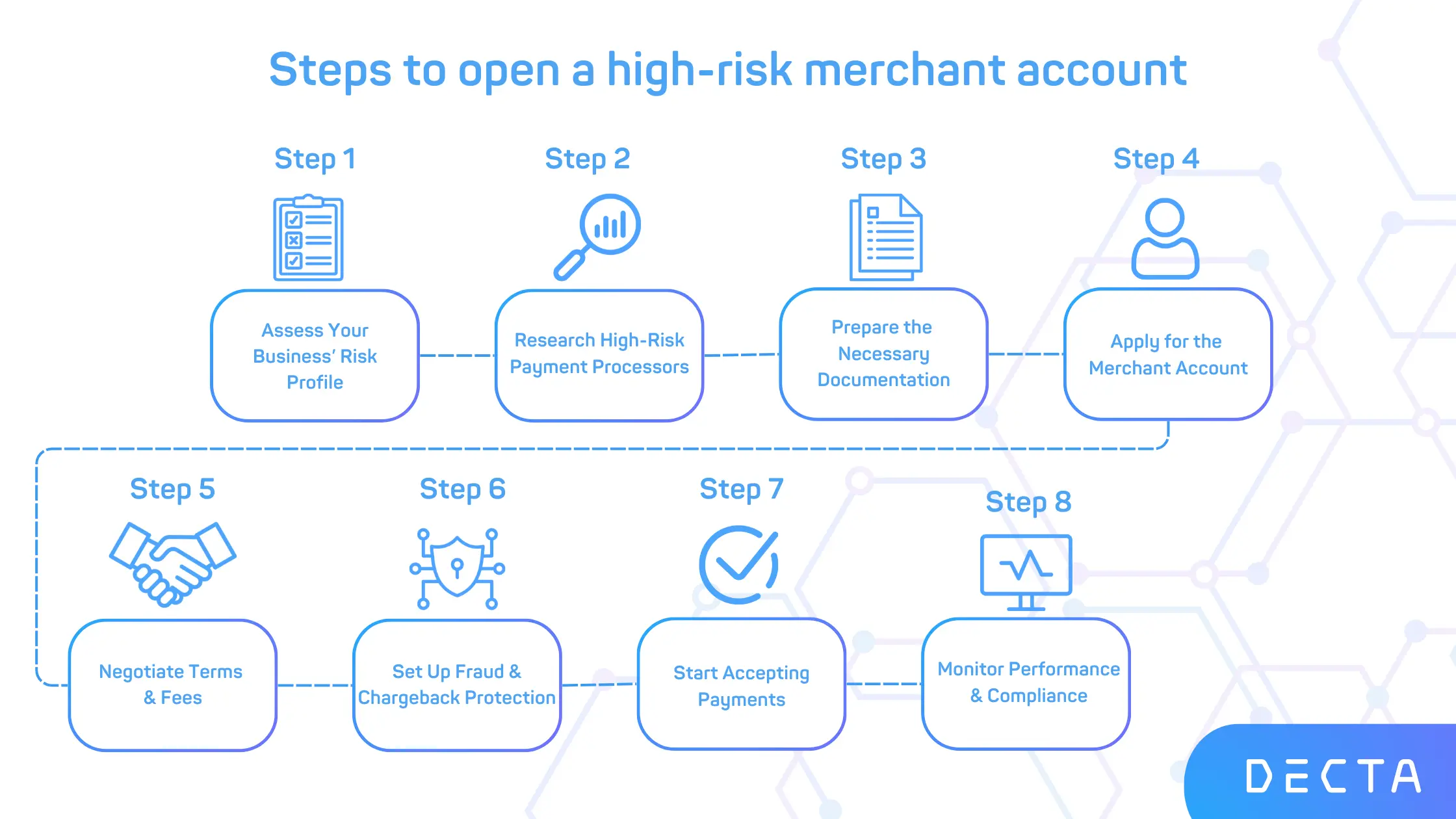
Step 1: Assess Your Business' Risk Profile
The first step, before applying for a high-risk merchant account, is to assess the risk profile of your business. Consider factors such as your industry, chargeback history, and the nature of your products or services.
Card schemes such as Visa and Mastercard classify every business with a Merchant Category Code (MCC) based on what it sells, and acquirers treat certain MCCs, such as gambling, dating, or nutraceuticals, as high risk by default. That classification shapes the fees, reserves, and documentation you will face during the high-risk merchant account application.
Financial institutions perceive certain risk factors, such as international sales or card-not-present transactions, as indicators of a high-risk business. Card-not-present payments, made online, by phone, or by mail, carry more risk because the physical card is never verified, which makes fraud and chargebacks more likely.
Understanding your business's risk level will help you identify the right payment processor and prepare for the application process.
Step 2: Research High-Risk Payment Processors
Not all payment services and merchant account providers are equipped to handle high-risk accounts. Next, research high-risk payment processors that have a proven track record of working with businesses in your industry.
Behind every processor sits an acquiring bank, a Visa or Mastercard member that underwrites your account and sets its risk appetite. Check which acquirers a provider works with and whether they accept your vertical before you apply.
Look for merchant account providers that offer tailored solutions, dedicated account managers, and robust risk management tools. Reading reviews and testimonials can also provide insight into the reliability and support offered by these high-risk payment processors.
Step 3: Prepare the Necessary Documentation
To apply for a high-risk merchant account, you will need to prepare several documents. Common requirements include:
Financial Statements: Recent bank statements as well as profit and loss statements to demonstrate your business's financial stability.
Business License: Proof of your business's legal status and compliance with local regulations.
Chargeback History: Documentation of your chargeback history, if applicable, to show your risk management practices.
Identification: Personal identification for the business owner(s) and any partners.
Providers use these documents for KYC (Know Your Customer) and AML (anti-money laundering) checks, which every acquirer must complete before approval. Incomplete files are one of the most common reasons applications stall.
Having these documents to hand will help streamline the application process and give you a greater chance of approval.
Step 4: Apply for the Merchant Account
Once you have assessed your own high-risk business profile, researched payment processors, and prepared your documentation, the next step is the application process for the merchant account.
Fill out the application form provided by your chosen high-risk payment processor, ensuring that all information is accurate and complete.
Be prepared to answer questions about your business operations, sales volume, and the nature of your products or services. These answers feed the underwriting review, in which the provider decides whether to approve your account and on what terms.
Step 5: Negotiate Terms & Fees
After submitting your application, you may receive an offer from the payment processor. Take the time to review the terms and fees associated with the high-risk merchant account.
High processing fees and rolling reserves are common in high-risk accounts, but you may be able to negotiate slightly lower fees or more favourable terms based on your business's financial stability and chargeback history.
Don't hesitate to ask for clarification on any terms that seem unclear.
Step 6: Set Up Fraud & Chargeback Protection
Once you get approved for a high-risk merchant account, implement fraud and chargeback protection measures.
Work with your payment processor to set up some risk assessment and management tools that can help detect and prevent fraudulent transactions. This may include implementing Address Verification Service (AVS), Card Verification Value (CVV) checks, and chargeback alerts.
AVS: compares the billing address entered at checkout with the address held by the card issuer.
CVV checks: confirm the buyer has the card's security code.
Chargeback alerts: flag a dispute early, so you can refund the customer before it turns into a chargeback that counts against your ratio.
3D Secure authentication is also worth enabling for card-not-present payments. When a transaction is authenticated with 3D Secure, liability for most fraud-related chargebacks generally shifts from the merchant to the card issuer.
Step 7: Start Accepting Payments
With your high-risk merchant account set up and fraud protection measures in place, you can start processing payments.
Ensure that your payment processing system is integrated with your website or point-of-sale system, allowing you to accept credit card payments seamlessly.
Monitor transactions closely, especially during the initial stages, to identify any potential issues early on.
Your setup must also maintain PCI DSS compliance, the card industry's data security standard. Using your provider's hosted payment page or tokenization reduces how much card data your own systems handle, and with it your compliance burden.
Step 8: Monitor Performance & Compliance
After you start accepting payments, monitor your account's performance and compliance regularly. Keep an eye on transaction volumes, chargeback rates, and any changes in your business operations that may affect your risk profile.
Visa and Mastercard both run monitoring programs that penalise merchants whose chargeback or fraud ratios exceed set thresholds, so keeping your chargeback ratio low protects both your fees and your account.
Maintaining a good relationship with your payment processor and staying compliant with their terms will help ensure the longevity of your high-risk merchant account.
Common Challenges for High-Risk Merchants & How to Handle Them
There are some common challenges for a high-risk business in the process of opening a high-risk merchant account. The three below are the usual suspects with suggestions on how to avoid the pitfalls.
High Processing Fees
High-risk merchant accounts often come with higher processing fees. To mitigate this, shop around for competitive rates and negotiate with your payment processor or account provider.
Rolling Reserves
Many high-risk providers require a rolling reserve, which is a percentage of your sales held in reserve to cover potential chargebacks. Understand the terms of the reserve and plan your cash flow accordingly.
Account Termination
High-risk accounts are more susceptible to termination. To avoid this, maintain a low chargeback ratio and comply with your processor's terms and conditions.
Merchants terminated for reasons such as excessive chargebacks or fraud can be added to Mastercard's MATCH list (Member Alert to Control High-risk Merchants), where records typically stay for five years and make it much harder to open a new merchant account.
High-Risk Merchant Account FAQs
How do I Know if My Merchant Account is Considered High Risk?
Your merchant account may be considered high risk if you operate in a high-risk industry, have a history of excessive chargebacks, or engage in card-not-present transactions.
What are Some Examples of High-Risk Merchant Accounts?
Examples of high-risk merchant accounts include:
Online gambling and casinos
Nutraceuticals, supplements and pharmaceuticals
Travel services
Credit repair businesses
Online Dating Services
Fantasy sports
How DECTA Can Help High-Risk Merchants
DECTA specialises in providing comprehensive payment infrastructure solutions, catering to various stakeholders in the financial ecosystem, including payment service providers (PSPS), banks, and merchants. Our offerings encompass a wide range of services from payment acquiring to issuing and processing.
Rather than applying blanket rejections, DECTA evaluates high-risk merchants on a case-by-case basis and builds a bespoke fraud management strategy for each client.
Robust risk management tools and regulatory compliance help mitigate potential issues, giving high-risk merchants the confidence to accept credit card payments without the fear of account termination.
Additionally, dedicated account management and bespoke solutions mean that businesses can receive the personalized support they need to thrive in a competitive landscape.
Ready to simplify high-risk payment processing?
Get expert support and acquiring solutions tailored to your business, with a dedicated account manager from day one.