This guide explains how rolling reserves work, why they’re used, who they affect, and what they mean for your cash flow.
February 25, 2026
In simple terms, a rolling reserve is a risk management measure used in payment processing where a payment provider temporarily holds a small percentage of a merchant's card transactions for a set period of time.
Those funds sit in a separate reserve account and are released gradually, transaction by transaction, as they move past the agreed holding period.
Why does this exist? Because card payments come with risk. Chargebacks, refunds, and fraud can all happen weeks or even months after a transaction is processed.
A rolling reserve acts as a financial buffer, helping payment providers cover those potential costs while still allowing businesses to accept card payments and grow.
In this article, we'll walk you through how rolling reserves actually work, why they're used, who they apply to, and - most importantly - what they mean for your cash flow.
Content Summary
This article explains what a rolling reserve is in payment processing, how it works, and why payment providers use it as a risk management tool.
Rolling reserves are often poorly understood and can feel restrictive for merchants, especially when they impact cash flow. However, they exist to manage delayed risks such as chargebacks, refunds, and fraud that occur long after a card transaction is processed, particularly in higher-risk or fast-growing businesses.
Key Takeaways:
A rolling reserve is a percentage of a card transaction (typically 5-15%) temporarily held by a payment provider and released gradually after a set holding period.
The 'reserve' rolls continuously, with new transactions entering the reserve while older funds are released, creating an ongoing risk buffer rather than a one-time hold.
Payment providers use rolling reserves to manage delayed liabilities like chargebacks, refunds, and card scheme penalties without disrupting merchant payouts.
Rolling reserves are most common for high-risk industries, new businesses, subscription models, seasonal merchants, and companies processing large or cross-border transaction volumes.
Different reserve types exist - rolling, up front (fixed reserve), and capped - each with different cash flow implications.
While rolling reserves do impact short-term cash flow, they become more predictable over time and can often be reduced or removed as a merchant's risk profile improves.
Transparent communication and regular reviews with a payment provider are key to managing, negotiating, or reducing reserve terms.
Readers can gain a practical, jargon-free understanding of rolling reserves, how they affect cash flow, and how working with a transparent provider like DECTA can help manage risk without blocking growth.
How Does a Rolling Reserve Work?
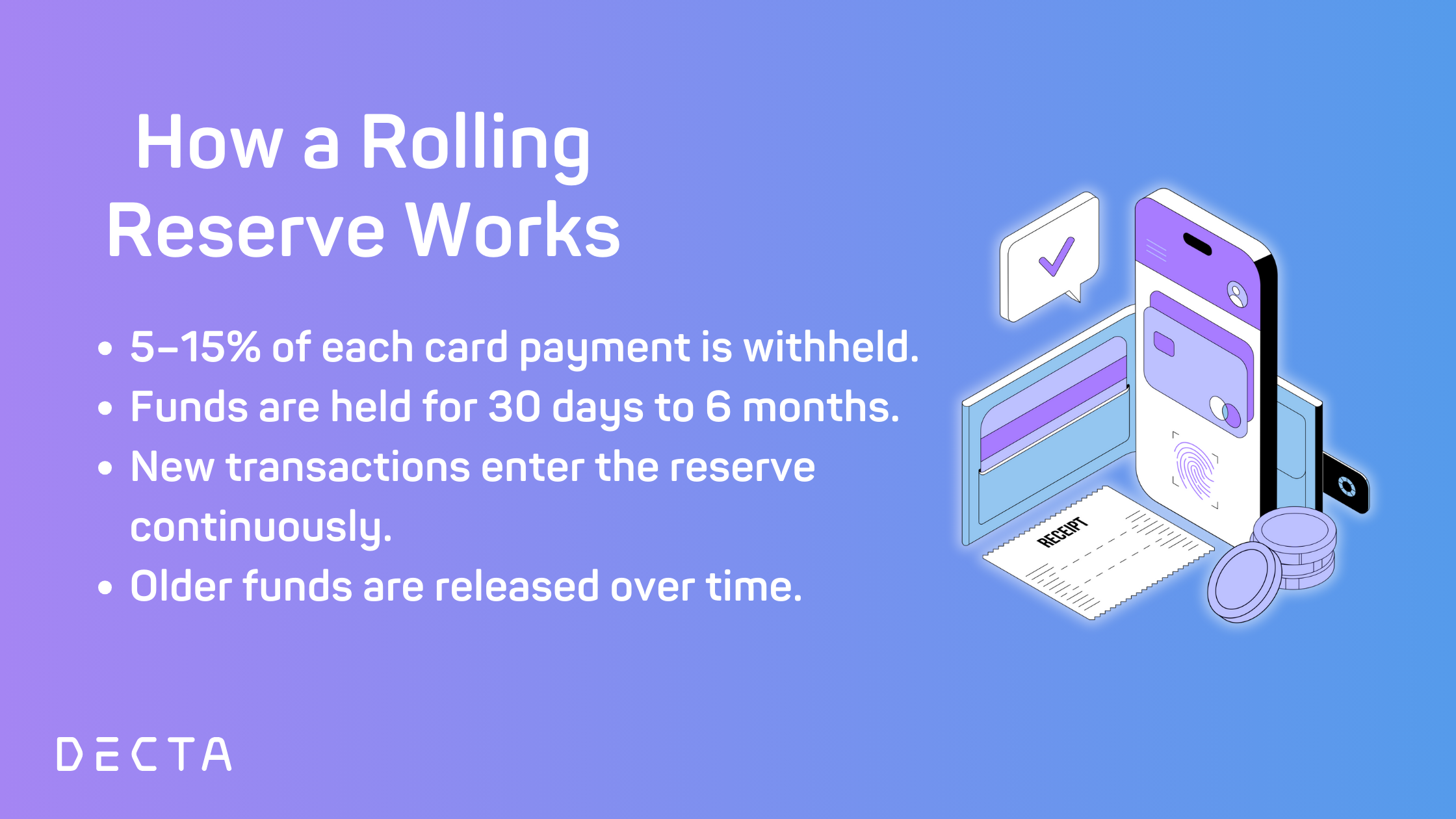
A rolling reserve works quietly in the background of your merchant account, tied directly to your card payment activity. Each time a customer makes a card payment, your payment processor withholds a pre-agreed percentage of that transaction in a reserved fund - usually somewhere between 5% and 15%, depending on your business model and risk profile.
That withheld amount is placed into a non-interest-bearing reserve account for a specific period, often somewhere between 30 days and 6 months.
The 'rolling' part simply means this isn't a one-off hold. Instead, every day (or month), new transactions enter the reserve account while older ones are released gradually as they move beyond the specified period.
So rather than locking away a lump sum, the reserve moves on a rolling window:
Today's transactions are partially withheld.
Transactions from 30, 60, or 180 days ago are released.
The remaining portion continues to roll forward.
Over time, this creates a steady rhythm of ongoing protection for the payment provider and a predictable release of funds for the merchant - once the reserve is fully established.
It's not designed to stop you from processing payments, but to make sure everyone is protected if chargebacks, refunds, or other payment issues arise later on.
Why Do Payment Providers Use Rolling Reserves?
Rolling reserves exist because card payments don't settle in real time. A transaction might look complete today, but chargebacks, refunds, or disputes can appear weeks - sometimes months - later.
From a payment provider's perspective, that creates a timing gap between when funds are paid out and when potential liabilities show up.
A rolling reserve helps close that gap.
By holding a small percentage of a merchant's processed volume, payment providers create a buffer that can absorb unexpected costs like chargeback fees, card scheme fines, or refunds, without having to interrupt payouts or pause processing.
It's a form of risk management, not a penalty - and in many cases, it's what allows certain businesses to be approved for a merchant account in the first place.
Rolling reserves are most commonly used when:
A business operates in a higher-risk sector.
Sales volume fluctuates significantly.
The business is new or has a limited processing history.
There's a likelihood of future returns or chargeback costs.
From the merchant side, it can feel restrictive - especially when cash flow is already tight.
But in practice, a rolling reserve often acts like an insurance policy for the payments ecosystem. It protects the provider from losses, yes, but it also helps ensure that the merchants can continue accepting card payments without sudden account restrictions if something goes wrong.
Which Businesses Are Most Likely to Have a Rolling Reserve?
Not every business will have a rolling reserve, but some are more likely than others - usually because of how card schemes and payment providers assess risk.
Rolling reserves are most commonly applied to businesses that:
Operate in high-risk industries such as travel, gaming, adult entertainment, gambling, telemarketing, or subscription-based services.
Are new or early-stage, with little or no card processing history.
Have seasonal or fluctuating sales volumes, where refunds may arrive long after the original transaction.
Process high transaction values or large volumes of card payments.
Sell internationally or process a high-level of cross-border transactions.
In many of these cases, the risk isn't about doing anything wrong - it's about timing and exposure. For example, travel businesses often take payment months before a service is delivered, causing an average chargeback value of $120. Subscription models can see disputes well after the initial sign-up. And newer businesses simply haven't had time to prove a consistent chargeback track record yet.
Rolling Reserve vs Other Types of Reserves
Not all reserves work the same way - and understanding how they operate can have a big impact on your cash flow.
Here's a clear, no-jargon breakdown of the most common reserve types you'll come across in payment processing.
Rolling Reserve
A rolling reserve withholds a set reserve percentage of each card transaction and holds it for a specific period. As each transaction moves beyond that window, the reserved funds are released gradually.
This creates a rolling cycle:
New transactions enter the reserve.
Older transactions are released.
The reserve balance constantly refreshes.
Rolling reserves are flexible and scale with your business - which is why they're commonly used for high-risk or fast-growing merchants.
Up front (Fixed) Reserve
An up-front, or fixed, reserve requires a business to provide a lump sum at the start of the contract. This fixed amount is agreed in advance and held for a reserve period, regardless of daily transaction volume.
While this option avoids ongoing withholding from every transaction, it can be cash-intensive up front reserve and isn't always practical for growing or early-stage businesses.
Capped Reserve
A capped reserve is a variation of a rolling reserve. A percentage of each transaction is withheld, but only until the reserve reaches a pre-agreed maximum amount.
Once that cap is hit, no further funds are held - unless the reserve is used and needs to be replenished.
This can offer a useful middle ground, limiting long-term cash flow impact while still providing the merchant account provider with a safety net.
How Rolling Reserves Affect Cash Flow
There's no getting around it - a rolling reserve does impact cash flow, especially in the early stages. Because a set percentage of your card payments is withheld for a pre-agreed schedule, you won't see the full value of every transaction's total land in your account straight away.
For most businesses, this can feel restrictive at first. Other financial liabilities, like day-to-day operations, need funding, suppliers still need to be paid, and forecasting becomes more complex when part of your revenue is temporarily out of reach.
The dynamic nature of rolling reserves - where the amount withheld changes in line with daily or monthly sales - can also make budgeting feel less predictable.
That said, once a rolling reserve contract is fully established, it becomes more manageable than expected. Funds are released on an ongoing basis, creating a steady flow back into your account rather than a long-term hold.
Some businesses even treat it as a form of forced savings, helping them stay protected against refunds or chargebacks without dipping into working capital.
The key is planning. Knowing your reserve percentage, holding period, and release schedule allows you to forecast accurately and build the reserve into your wider business processes.
With transparency from your rolling reserve merchant account provider, it doesn't have to block growth - it just becomes another moving part to manage.
Can a Rolling Reserve Be Reduced or Removed?
In many cases, yes - a rolling reserve can be reduced, and sometimes removed altogether. It isn't always a permanent feature of a merchant account, especially if it was introduced to manage early-stage or sector-specific risk.
Payment providers regularly perform a risk assessments to review rolling reserves based on how a business performs over time. If you're consistently processing payments smoothly, keeping chargebacks and refunds low, and maintaining a healthy financial profile, that risk picture charges - and your reserve teams can change with it.
You may be able to request a reduction or removal if:
You've built a strong processing history over several months.
Your chargeback ratio remains well within card scheme thresholds.
Your business model or sales patterns have stabilised.
You can demonstrate improved financial health or controls.
That said, reserves aren't always removed overnight. Reductions often happen gradually, such as lowering the percentage, shortening the holding period, or introducing a cap. The goal is to balance reduced risk with continued protection for everyone involved.
This is where your relationship with your payment provider really matters. Clear communication, transparency, and ongoing due diligence can make a real difference.
A good payments provider will treat a rolling reserve as something to review and revisit, not a fixed condition you're stuck with forever.
FAQs
Is a Rolling Reserve a Bad Thing?
No. A rolling reserve is a risk management tool used by payment providers in which a portion of transaction funds is temporarily held to cover potential chargebacks, refunds, or fraud. It is often applied to new or higher-risk businesses as part of standard payment processing practices.
What Percentage is Usually Held in a Rolling Reserve?
Typically, between 5% and 15% of card transaction volume is held in rolling reserve, depending on the risk and business model.
How Long are Funds Held in a Rolling Reserve?
Usually between 30 days and 6 months, based on the agreed reserve period.
Is a Rolling Reserve Refundable?
Yes. Funds are released to the merchant once they have passed the holding period.
Do All Payment Processors Require Rolling Reserves?
No. They are mainly used for higher-risk, new, or complex businesses. However, businesses should always check the terms and conditions to avoid nasty surprises.
Can a Rolling Reserve Be Negotiated?
Often, yes - especially after a strong processing history is established.
What’s the Difference Between a Rolling Reserve & a Chargeback Fee?
A rolling reserve holds funds temporarily, while a chargeback fee is a direct cost charged per dispute.
Does a Rolling Reserve Affect Payouts?
Yes. A portion of each payout is withheld with payment processors releasing funds on an ongoing (rolling) basis, assuming no chargebacks or disputes occur.
Transparent, Flexible Payment Processing with DECTA
Rolling reserves shouldn't come as a surprise. If a reserve is required, we're upfront about it from the start - why it's there, how it works, and what needs to happen for it to be reviewed or reduced.
No vague clauses. No confusing explanations. Just clear, honest conversations.
At DECTA, we take a practical, balanced approach to risk. We look at how your business actually operates, not just which box we can quickly fit it into. That means setting rolling reserve terms that are appropriate, proportionate, and designed to be revisited as your business grows and your risk profile improves.
If you're exploring a merchant account, questioning how your current provider handles reserves, or simply want a payments partner who explains things properly, DECTA's processing solutions are built to support you - only with positive friction.