Payment gateway types fall into four categories, and knowing which one fits your business is essential for any online business owner setting up payments for eCommerce. A payment gateway is the technology layer that carries card data from your checkout to the acquiring bank and back, so the type you choose decides who holds the customer at the moment of payment, who carries the security burden, and what each transaction costs you.
This article compares the four types of online payment gateways side by side, so you can weigh the advantages and drawbacks of each and make a well-considered choice.
1. Hosted Payment Gateway
A hosted payment gateway works by redirecting customers to a third-party payment service provider (PSP) page to complete transactions. The PSP is the company that operates the gateway and connects it to the acquirer, the licensed bank that actually settles the money into your account.
Because the payment happens on the PSP's page, that external checkout system manages all transaction related tasks, such as data collection and security. Small businesses often prefer hosted payment gateways for their ease of use and security features.
The robust security measures of a hosted payment gateway are a clear advantage compared to gateways you host yourself. With the PSP handling payment information, merchants can trust the gateway to maintain PCI DSS compliance and provide strong fraud protection. PCI DSS: the card industry's security standard for handling cardholder data. Because card details never touch your servers with this gateway type, your compliance scope shrinks to the lightest self-assessment tier, which reduces the security responsibilities on the merchant's end.
In contrast to the other gateway types, hosted payment gateways are also simpler to set up and integrate. They are designed with user-friendliness in mind and typically do not require extensive technical knowledge. Merchants can establish the payment process using ready-made templates from the PSP, or a plugin for platforms like Shopify and WooCommerce.
The trade-off is that redirecting customers to a third-party site may disrupt the checkout flow and increase the risk of cart abandonment, the point at which a shopper leaves before paying. Every extra page load between the basket and the confirmation costs conversions, which is why the redirect is the main argument against this gateway type.
Some hosted gateways offer customised pages to uphold brand identity and enhance the checkout experience.
2. Self-Hosted (On-Site) Payment Gateway
A self-hosted payment gateway collects payment information on the merchant's own website. That data is then sent to a third party for authorisation, the step where the issuing bank approves or declines the transaction. By keeping the checkout process within their sites, merchants can create a smooth and unified experience for customers.
A major advantage of self-hosted payment gateways, compared to hosted ones, is controlling the checkout process. Merchants can personalise the payment page according to their brand and optimise it for conversion rates. This customisation can reduce abandoned carts and boost conversions.
The drawback of this level of control is the responsibility that comes with it. Because card data passes through your own systems, self-hosted gateways push you into a heavier PCI DSS tier, usually SAQ A-EP or SAQ D, which means annual scans, documented controls and TLS encryption across the payment page.
You also need to support 3D Secure 2, the cardholder authentication step that satisfies strong customer authentication under PSD2 and shifts fraud liability from you to the issuing bank when a payment is challenged.
This requires expertise in technology and resources for integration, upkeep and issue resolution.
Run the Gateway Under Your Own Brand
DECTA provides a market-ready white label payment gateway with acquiring connections, back office, and 3D Secure already built in.
Self-hosted payment gateways are better suited to businesses handling large transaction volumes, where the costs of ensuring security and compliance are balanced by the sales volume. If your business deals with a high transaction volume, opting for a self-hosted gateway can be cost-efficient.
Another criterion to weigh is the need for customisation. If your business requires customisation of the checkout process to improve user experience and maintain brand coherence, a self-managed payment gateway is a suitable option. This type of gateway lets you personalise the checkout process according to your needs.
Expertise is vital when setting up a self-hosted payment gateway. Businesses possessing the proficiency to handle security, compliance, and integration complexities gain the most from this type of gateway. If your team has the skills and resources, a self-hosted gateway can offer a highly adaptable and secure payment solution.
Another advantage of self-hosted payment gateways is control over customer data. Full control over customer data can be advantageous for marketing initiatives and managing customer relationships effectively.
It also makes tokenisation useful: replacing the card number with a token lets you offer one-click and recurring billing on repeat purchases without ever storing the card itself, which is the requirement behind any subscription model.
3. API-Hosted Payment Gateway
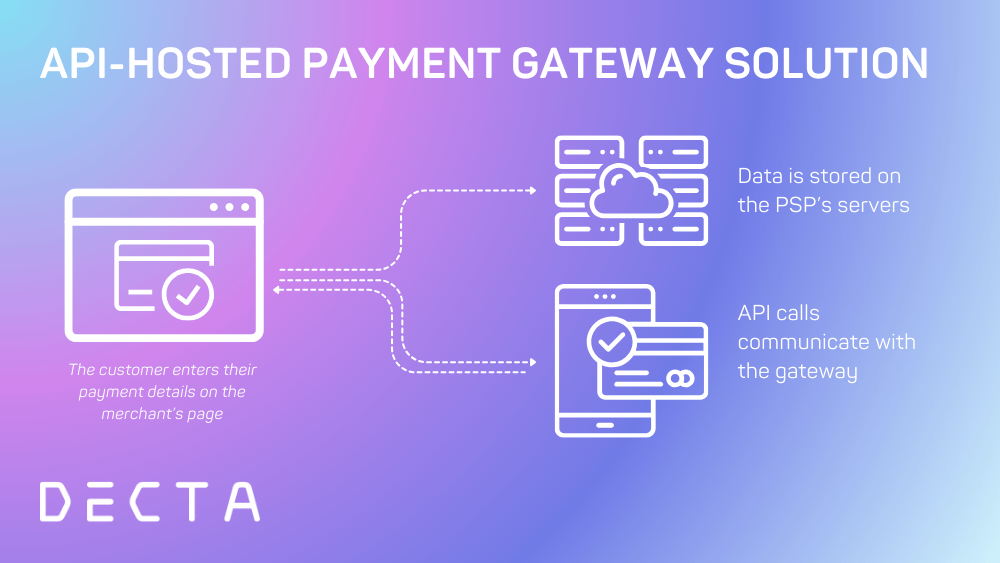
An API-hosted payment gateway integrates payment processing directly into a merchant's website through API calls, offering a customised checkout experience with no redirect at all. This type of gateway gives businesses control over the payment process and customer interaction, making it a preferred option for companies with dedicated development teams.
A key advantage of using an API-hosted payment gateway is its adaptability and integration capabilities. These gateways can be integrated with most platforms and tailored to match the website's design and functionality, and they usually expose payment scenarios that hosted gateways do not:
Pay-by-link for invoicing and payments that happen outside a standard checkout
MOTO for mail order and telephone order sales taken by a call centre
Payouts back to the original card, used for refunds and disbursements
This level of customisation enables businesses to create a checkout experience that aligns with their specific requirements.
As with self-hosted gateways, this control comes with the responsibility of ensuring security and compliance with PCI DSS regulations. Merchants utilising API-hosted gateways need to implement security measures to safeguard payment data. This requires technical expertise and resources for integration, maintenance, and troubleshooting.
Many providers reduce that burden with hosted fields or an iFrame, which keeps card entry inside the provider's PCI scope while the surrounding page stays yours.
Additionally, API-hosted payment gateways offer scalability, making them well-suited for expanding businesses. As your business grows and transaction volumes rise, an API-hosted gateway can effectively manage the increased workload.
It is also the only gateway type that supports omnichannel processing, where online and in-store payments run through one integration and settle into one report.
How does an API-hosted payment gateway differ from a Self-Hosted (On-Site) Payment Gateway?
While API-hosted and self-hosted payment gateways both offer significant control over the checkout process, there are key differences between the two.
Integration effort
Security responsibility
Customisation
Scalability
API-hosted
More advanced technical integration
Merchant manages it; API may add protection
Extensive, end to end
Handles rising volumes well
Self-hosted
Lighter, but still hands-on
Merchant manages it in full
Full control of the payment page
Scales with your own infrastructure
API-hosted gateways give flexibility when it comes to integrating with various platforms and customising the payment experience. This flexibility allows businesses to design a tailored checkout process that fits their requirements.
On security responsibilities, both types of gateways need the merchant to manage security and compliance. However, API-hosted gateways might provide security features through the API, which adds a layer of protection for payment data.
The added implementation complexity can pose a challenge for businesses without development resources.
Lastly, API-hosted gateways are often more scalable, making them suitable for businesses anticipating growth. As a business expands, an API-hosted gateway can effectively manage increasing transaction volumes, providing a scalable payment solution.
Popular API-Hosted Payment Gateway Providers
Stripe and PayPal are the two most recognised providers in this category, and comparing them shows the range within a single gateway type.
Stripe is highly regarded for its developer approach, which offers comprehensive documentation and assistance for seamless integration with different platforms and programming languages. It boasts features like currency support, recurring billing options, and advanced fraud prevention mechanisms, making it a versatile choice suitable for businesses of all sizes.
PayPal, by contrast, is known for its user-friendly interface and widespread consumer recognition, which can lift conversion on its own. It supports international transactions and carries robust security measures, but it is closer to the hosted model in practice, since much of its flow still hands the customer over to PayPal.
For businesses that want the API-hosted experience under their own name rather than a provider's, a white label payment gateway is the third option: the provider runs the infrastructure, acquiring connections and back office, and the whole thing carries your branding and domain.
4. Local Bank Integration Gateway
Local bank integration gateways connect directly to domestic banks to handle payments, usually guiding customers to their own bank's platform to authorise the transaction. In Europe this model overlaps with open banking, the framework PSD2 created, and the account-to-account payments it enables, which move money straight from the shopper's bank account without a card in the middle.
This gateway type is well suited for businesses targeting geographical areas as it aligns with local payment preferences and contributes to building customer confidence.
The key advantage of local bank integration gateways, in contrast to global providers, is their capacity to cater to regional enterprises. Through links with local banks, these gateways deliver a familiar and trusted payment process for customers.
The main drawback is that bank integration gateways are limited when it comes to international transactions. These gateways may not accommodate multiple currencies or cross-border payments, restricting their utility for global enterprises. If your business operates on a scale, exploring alternative payment gateway solutions may be necessary.
The complexity of integrating bank integration gateways can vary based on the respective banks infrastructure. While some banks offer integration procedures, others may demand greater technical know-how and resources.
Local bank integration gateways are particularly suitable for medium-sized and small enterprises concentrating on localised markets. Their lower transaction costs come from bypassing card scheme interchange entirely.
Chargebacks also work differently here: a bank transfer is not reversible the way a card payment is, so you carry less dispute risk but also give the customer less recourse.
How Fees Compare Between Payment Gateway Types
Transaction fees by gateway type
When comparing transaction fees among payment gateways, take into account both the initial setup expenses and the ongoing charges per transaction.
Gateway type
Hosted
Self-hosted
API-hosted
Local bank integration
Setup and upkeep
Lower
Higher
Higher
Varies by bank
Per transaction
Higher
Lower
Lower
Lower
Various factors can impact transaction charges, such as high transaction volumes, specific payment methods and negotiated rates. Businesses with steady volume can negotiate reduced fees with their payment gateway provider. Payment methods also differ. Bank transfers and account-to-account payments avoid interchange, the fee the card schemes pass to the issuing bank, so they usually cost less than credit card payments.
There are trade-offs linked to lower fees. Lower charges may involve trade-offs in terms of functionalities, assistance, and security. For instance, a gateway offering reduced transaction costs might have features or less robust customer support services.
Hidden Costs
Hidden expenses can impact the total cost of using a payment gateway. Common ones include:
Chargeback fees, charged per disputed transaction whether or not you win the dispute
Currency conversion margins applied on every non-domestic sale
Add-ons for fraud screening or 3D Secure, billed separately from the transaction fee
To uncover hidden charges, examine the contracts and terms of service thoroughly. Be on the lookout for any fees that may not be immediately obvious, such as those tied to chargebacks or currency conversion. It's also important to consider how these hidden costs could affect your pricing model.
One approach to reducing costs is to engage and negotiate with your payment gateway provider regarding the terms of your agreement. Through negotiation, you can lower or eliminate fees. Opting for gateways that offer pricing structures can also help avoid unexpected charges.
Cross-border transactions
Cross-border transactions incur higher fees than domestic ones due to currency conversion and additional processing costs. These fees can differ greatly depending on the service providers. They should be taken into account when handling international payments. For instance, some providers may impose a fixed fee for converting currencies. In contrast, others may levy a percentage of the transaction amount.
Complying with regulations can also increase the expenses associated with cross-border transactions. Adhering to rules like GDPR or PSD2 might demand more resources and incur additional costs, since PSD2 requires strong customer authentication on most European transactions and each authentication step has a cost attached.
It's crucial to factor in these compliance expenses when dealing with international payments.
Certain service providers specialise in handling transactions and offer lower fees and enhanced support for cross-border payments. By selecting providers that offer terms for international dealings, businesses can reduce currency conversion charges and trim down the overall expenses linked to cross-border payments.
Monthly fees
Monthly fees for payment gateways can differ widely. Some gateways charge a fixed monthly platform fee on top of per-transaction charges, while others provide no-fee options for merchants with lower sales. When selecting a payment gateway, weigh the balance between fixed fees and transaction volumes.
For businesses that process a high number of transactions, monthly fees are often more economical, since they tend to come with lower per-transaction costs. By paying a fee, businesses can enjoy reduced transaction fees and extra perks like enhanced reporting and protection against fraud.
Certain gateways use tiered or interchange-plus pricing that varies with transaction volume, which changes what you actually pay per sale. Furthermore, consider the worth of features included in the fee, like advanced reporting, fraud protection, and customer assistance.
Businesses with fluctuating sales should opt for gateways with adaptable monthly fee structures. This approach helps prevent paying for services during slow periods and maintains cost-effectiveness throughout the year.
Can You Integrate Multiple Payment Gateways on One Website
Yes, you can run more than one gateway on a single website, and many merchants combine gateway types deliberately: a hosted or local bank gateway for one market, an API-hosted gateway for another.
It can boost transaction success rates through payment routing, which sends each transaction to the connection most likely to approve it, provide a fallback if one provider goes down, and offer customers a wider choice of payment methods. By incorporating gateways, businesses can deliver a more adaptable and dependable payment process.
Nevertheless, incorporating gateways requires thorough planning and technical know-how. It's crucial to guarantee that the gateways are smoothly integrated and function without any issues.
This might involve implementing management systems and conducting regular checks to confirm the proper functioning of all gateways.
Running several gateways can also enhance user satisfaction by presenting preferred payment methods and decreasing the chances of transaction failures.
Managing gateways entails reconciling transactions across different platforms, which can be intricate and time-consuming. Having a payment management system in place is vital to streamlining the reconciliation procedure and maintaining precise transaction records.
Effective strategies for integrating several payment gateways encompass utilising a payment management system consistently monitoring gateway performance and upholding uniform branding and user experience across all payment avenues.
Summary
Selecting the right payment gateway is a decision that can significantly influence your success in eCommerce.
Hosted payment gateways offer simplicity and the lightest PCI DSS burden, while self-hosted gateways provide control over the checkout at the cost of heavier compliance. API-hosted gateways provide flexibility, omnichannel reach and scalability, whereas local bank integration gateways suit regional sellers who benefit from open banking and low-cost account-to-account payments.
When comparing fees, consider both the setup costs and the ongoing per-transaction charges. Look for any costs and how cross-border transactions can impact your overall pricing structure. Monthly fees can vary significantly, so it's essential to evaluate how fees relate to transaction volumes.
Integrating payment gateways onto a single website can bring several advantages but necessitates thorough planning and technical know-how.
Payment Infrastructure Built Around You
DECTA is a certified payment processor covering acquiring, issuing, and gateway services for merchants, PSPs, and banks.