A practical walkthrough of how stablecoin settlements fit into card acquiring: what changes in the merchant payout leg, what stays on standard card rails, the benefits for acquirers, and the regulatory and operational risks to weigh before adopting.
May 27, 2026
Stablecoin settlements in card acquiring are a means of paying merchants whose payment for card transactions is made via a stablecoin on the blockchain rather than via a wire transfer of fiat currency. A stablecoin is a type of cryptocurrency that maintains a set value relative to a reference currency such as the US dollar or euro. Common stablecoins are USDC, USDT and EURC. Payments made via stablecoins take place in minutes rather than days.
This solution is no longer theoretical. Visa has been settling with acquirers in USDC since 2021, first on Ethereum and later on Solana. Moreover, Mastercard has launched its Multi-Token Network that enables the same type of settlement. Both payment card schemes have published the stablecoins that are eligible for these settlements to be included within their standard payment infrastructure.
Key takeaways
Stablecoin settlements move the merchant payout leg of card acquiring on-chain. Authorisation and clearing stay on standard card rails.
The acquirer converts the net fiat owed to each merchant into a stablecoin (USDC, USDT, EURC) and sends it to the merchant's wallet — typically in minutes instead of 1–3 days.
Visa and Mastercard already support stablecoin settlement, so the model is production, not theory.
The biggest gains are in cross-border flows: faster payouts, lower correspondent banking costs, less pre-funded currency capital.
New risks and rules apply on top of existing acquiring obligations: de-pegging, issuer reserves, on-chain failures, plus MiCA and the US GENIUS Act.
What stablecoin settlements mean for acquirers
A stablecoin settlement is a change that occurs within the back-office functions of card acquirers when paying merchants. Customers do not experience any change in the purchasing process, and merchants do not experience differences in the prices of goods and services, the fees they pay to card acquirers or the outcomes of any chargebacks they receive from customers. The change refers to the method by which card acquirers pay merchants for the transactions that pass through their systems.
The standard method of paying merchants uses banking rails. Card acquirers calculate the net positions of each merchant through their transaction records. The calculated amounts are paid out to merchants through local banking rails such as SEPA, ACH, SWIFT or another regional system. However, settlements made through banking rails have some inherent drawbacks:
Settlement cycles take one to three business days (T+1 to T+3), with weekends and public holidays extending the wait.
Cross-border payouts pass through correspondent banks that each charge a fee and apply their own foreign exchange spread. World Bank data puts the average cost of sending USD 200 across borders at around 6 percent globally, with corridors into Latin America and sub-Saharan Africa routinely above that.
To ensure merchants are paid on time across multiple currencies, acquirers maintain pre-funded balances at partner banks in each currency they settle into.
A stablecoin settlement allows for the same calculation of net positions of merchants to be made but replaces the banking rail with an on-chain payment for merchants.
How a stablecoin settlement flow actually works
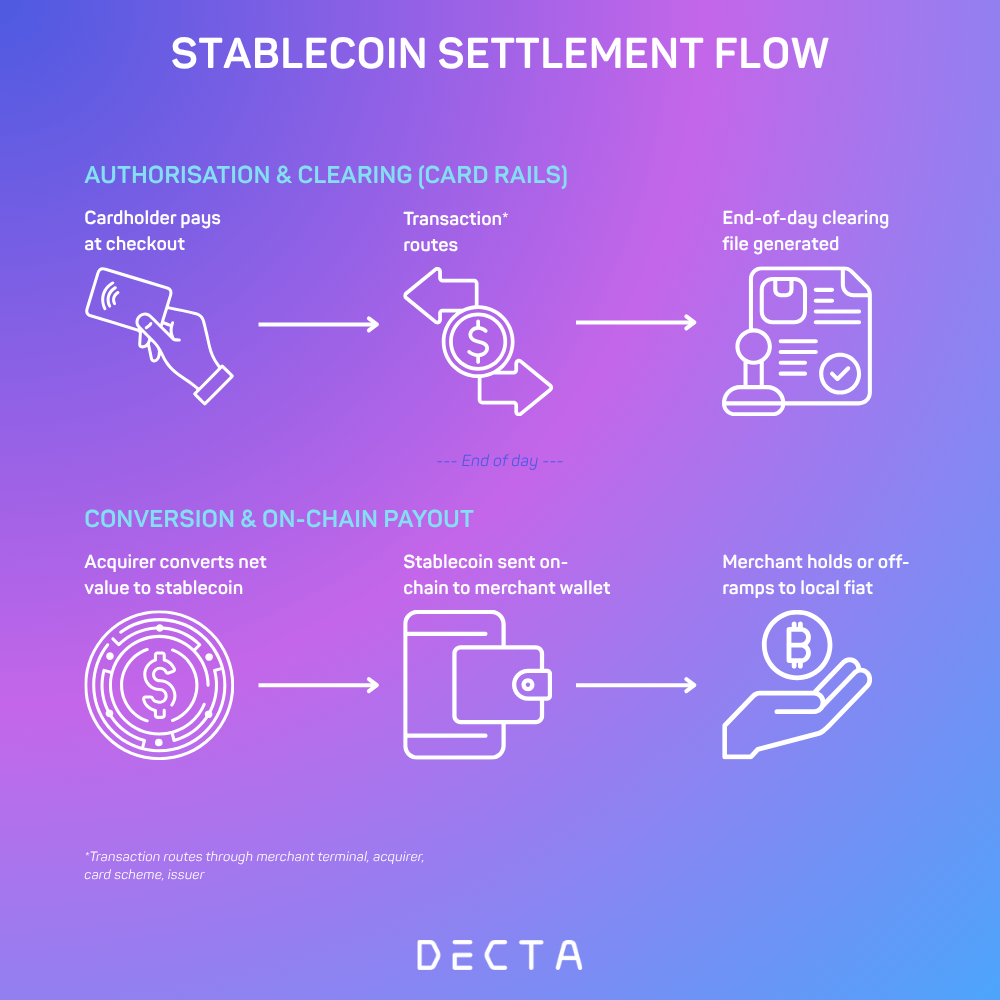
There are two different halves to the stablecoin settlement flow. The first half of the process occurs via the standard card rails and is independent of the stablecoin settlement process. The second half of the process replaces the bank wire with an on-chain transaction.
Authorisation and clearing stay on the card rails
The front end of the transaction follows the standard four-party model used in any card payment:
1. The cardholder enters their payment details at checkout on the merchant's website.
2. The transaction routes from the merchant's terminal through the acquirer and the card scheme (such as Visa or Mastercard) to the card issuer.
3. The issuer reserves the funds on the cardholder's account and returns an approval response to the merchant.
4. At the end of each day, the card scheme produces a clearing file that lists the net amount each merchant in the acquirer's portfolio is owed.
This process is independent of whether the payout is to occur as fiat currency or stablecoin.
Conversion and on-chain payout
The acquirer (or a third party on their behalf) takes the total value of the merchants that they have cleared during the day and converts that value into stablecoin. In practice, the choice of stablecoin is constrained by what the card schemes have approved for settlement use. Visa currently settles in USDC across Ethereum and Solana, and Mastercard's Multi-Token Network supports a defined list of regulated, fully reserved stablecoins. The stablecoins are sent directly to the merchant's cryptocurrency wallet. This process typically takes only a few minutes to complete. By contrast, a SWIFT wire takes between one and two business days and passes through several banks along the way.
From that point, the merchant has two options:
Hold the stablecoin in their wallet for use in other on-chain payments or transfers.
Off-ramp the stablecoin into local fiat currency through a conversion partner, such as a crypto exchange or a stablecoin-to-fiat service provider.
What stablecoin settlements unlock for acquirers
There are three main differences between fiat currency settlements and stablecoin settlements.
Faster settlements: In the current world of payment card settlements, merchants typically do not receive their funds until well after the day that they earned that revenue, typically between Monday and Tuesday. However, because stablecoins clear in minutes, the merchant can receive their funds at any time of the day or night, regardless of the local time zone of that merchant.
Lower cross-border costs: The costs of sending money through a SWIFT wire involve the fees of a number of correspondent banks, and their foreign exchange rates typically differ from the market foreign exchange rates. By contrast, stablecoins collapse that number of banks into one transaction at the acquirer, and the cost of sending the funds is a fraction of the cost of the SWIFT transaction. These cost savings are even more marked for merchants whose payments are sent to countries with thin or costly correspondent banking relationships.
Reduced working capital requirements: To pay merchants in their local currencies, the acquirer must have pre-funded currency accounts with each merchant's local banks. By contrast, the acquirer can pay merchants in a stablecoin that they can off-ramp into their local currencies. Therefore, these currency accounts no longer need to be pre-funded, and the working capital that the acquirer would have otherwise had to lay down for these accounts can be used elsewhere.
Parameter
Payout speed
Cross-border cost
Currency balances
Traditional settlement
1 to 3 business days, longer over weekends and public holidays
Correspondent bank fees and FX spread at each hop
Pre-funded balances at partner banks for each local currency
Stablecoin settlement
Minutes, regardless of day or hour
One conversion at the acquirer plus a low on-chain transfer fee
One stablecoin pays merchants across many countries who off-ramp themselves
Where stablecoin settlement beats domestic instant-payment rails
A reasonable question is whether instant-payment schemes such as SEPA Instant in Europe, FedNow and RTP in the United States, PIX in Brazil, and UPI in India already solve the problem of transaction settlement speed without the involvement of cryptocurrency. These domestic methods do solve the problem within the country in which the central bank is responsible for operating that domestic instant-payment system. None of these instant-payment systems solves the problem of cross-border transactions.
Each of these domestic instant-payment systems is a separate system with its own membership requirements, technology integrations, currencies, and operating hours. For an acquirer that would like to settle into merchants in Brazil, India, and Nigeria would have to have access to three of these domestic instant-payment systems, as well as the foreign exchange systems necessary to fund each of those domestic instant-payment systems. In contrast, using a single stablecoin that operates on a single blockchain allows the acquirer to settle into merchants in all three of these countries with only one software integration. This advantage of stablecoins over domestic instant-payment systems exists outside of the speed at which those domestic instant-payment systems are able to settle transactions.
Risks and regulatory issues to weigh
Adopting the use of stablecoins for transaction settlements does not remove any regulatory requirements from an acquiring company's obligations. All of the regulations that currently apply to the acquiring company, such as PSD2, PCI DSS, card scheme regulations, AML regulations, and sanctions regulations will continue to apply to those companies. In addition to these regulations, a new set of regulations and risks associated with stablecoins will be added to those existing regulatory requirements.
Regulatory exposure
The issuance of stablecoins is a regulated activity in the majority of the major jurisdictions for cryptocurrencies. The regulations that apply to acquiring companies that would like to use stablecoins to settle their transactions include the following two regulations:
Markets in Crypto-Assets (MiCA): the European Union framework that sets reserve, redemption, and disclosure requirements for fiat-referenced stablecoins used within the bloc, with stricter prudential requirements applied to coins classified as significant.
The US GENIUS Act: the United States federal framework that establishes equivalent rules for payment stablecoins issued and circulated in the US.
Those regulations will impact which stablecoins can be used by acquiring companies for transaction settlements. Each card scheme has its own list of stablecoins that are eligible for settlement use. Additionally, each stablecoin issuer must comply with the regulations of the markets in which it operates. Both of these factors will impact acquiring companies' decisions of which stablecoins to use in place of their domestic and cross-border transaction settlement methods.
The fiat-to-stablecoin conversion also adds AML and sanctions touchpoints to the acquiring company's operations that did not exist when the entire payout chain was on bank rails. These touchpoints include travel rule data on outbound transfers, wallet address screening, and on-chain transaction monitoring (often called know-your-transaction, or KYT, screening).
Operational and counterparty risk
The risks that should be evaluated prior to the introduction of stablecoin settlements fall into two categories: stablecoin-specific risks, and on-chain payout system risks.
The stablecoin-specific risks include the following:
De-pegging: a stablecoin can lose its peg to its reference currency during a market shock or a loss of confidence in the issuer.
Issuer and reserve risk: the entity that issues the stablecoin can fail, freeze redemptions, or change the composition of its reserves. Even regulated issuers have experienced reserve-related volatility.
The on-chain payout system risk includes the following:
Wallet compromise: a hot wallet used for payouts can be hacked or have its private keys leaked.
Smart contract risk: a bug in a bridge or other on-chain contract can cause loss of funds.
Chain-level disruption: a blockchain network can halt, fork, or reorganise.
Each of these risks should be evaluated by an acquiring company prior to the implementation of stablecoin transaction settlements.
What acquirers should evaluate before adopting
Three questions determine whether stablecoin settlement is worth implementing for a given acquirer.
The first evaluation is whether the transaction volume justifies the change. An acquirer that settles mostly with domestic merchants in a single currency sees a limited benefit from stablecoin settlement, since a domestic instant-payment rail already solves the speed and cost problem. An acquirer with significant cross-border volume into emerging markets, where correspondent banking is slow and expensive and no single instant-payment rail can reach all of them, sees benefits at a different scale.
The second evaluation is which implementation path to choose. Building stablecoin settlement in-house means setting up custody infrastructure, on-chain monitoring tools, conversion capabilities, and a team to operate them. Working with a settlement partner or a payment processor that already offers stablecoin payouts shifts most of this operational load externally, in exchange for partner fees and a degree of dependency.
The third evaluation is compliance readiness. An acquirer's existing compliance programme is built around card-present and card-not-present obligations. Extending it to support stablecoin settlement requires adding wallet screening, monitoring of stablecoin reserve risk, reporting to card schemes on stablecoin settlement activity, and audit evidence that on-chain flows reconcile with off-chain books. Treating these additions as an extension of the existing programme, rather than running a parallel one, helps keep the operating model coherent.
Building or scaling an acquiring business?
Talk to the DECTA team about your payment infrastructure.