The Payments Ecosystem Explained: Key Players, How It Works, and What's Changing
The payments ecosystem is the connected set of banks, networks, technology providers, and regulators that moves money from a customer's card or account into a merchant's bank account.
September 08, 2025
For payments product managers, merchants, PSPs, and financial institutions, keeping track of how issuers, acquirers, processors, and new entrants connect is key to building efficient and secure payment systems.
This article breaks down the ecosystem step by step, explores its main participants, and highlights the trends and strategies shaping payments today.
What Is The Payment Ecosystem?
The payment ecosystem refers to the arrangement of people, technology, and regulations that allow money to flow to and from you, your customers, and banks. It consists of all aspects of a transaction, everything from when a customer pays to when that money hits your bank account.
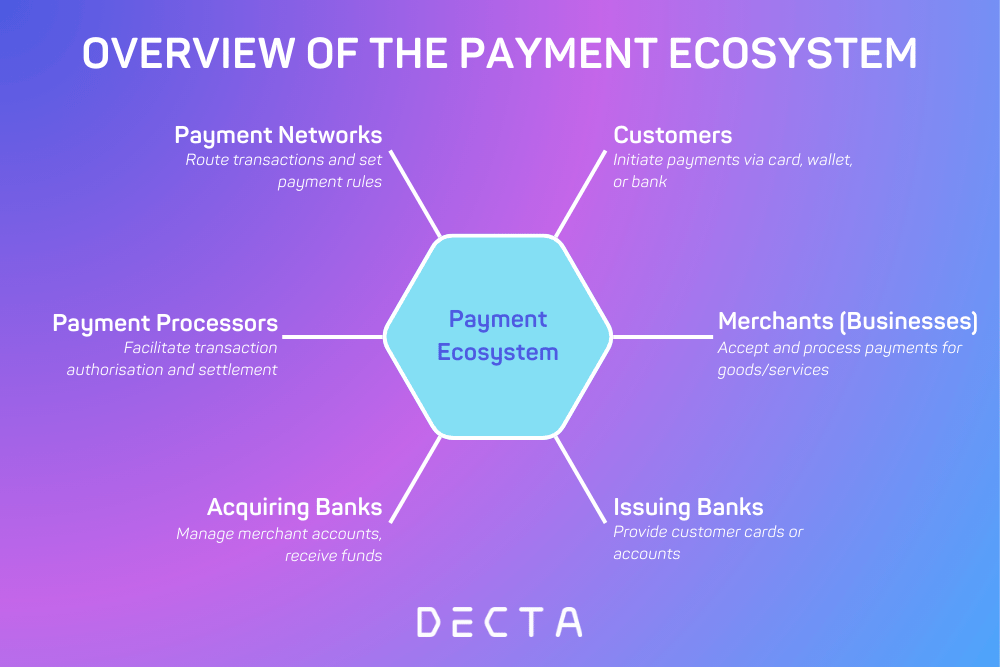
You encounter many players within the digital payments ecosystem:
Customers – Those who want to pay you—individuals or businesses.
Businesses – You—the merchant who wants to receive payments.
Payment networks – Card schemes (like Visa or Mastercard) that create rules and link banks.
Issuing banks – Banks that provide your customers with their cards or accounts.
Acquiring banks – Banks that take your customers' payments and deposit them in your account.
Payment processors – Companies that facilitate authorisation, clearing and settlement.
Payment gateways – Technology that securely transmits payment information online.
Regulators – Government institutions that create rules surrounding security, compliance and consumer rights.
Each essential element has a specific duty but relies on all others to properly authorise, settle, and ensure the payment isn't fraudulent.
Additionally, the payments industry also consists of complementary entities like merchant service providers, independent sales organisations (ISOs), payment service providers (PSPs), and payment facilitators, which help you get access to point-of-sale systems, fraud protection, and digital wallet payments. PSPs matter in particular because they bundle a gateway, acquiring connections, and merchant servicing into one commercial relationship, which is how most smaller merchants reach the card networks without dealing with a bank directly.
The ecosystem evolves over time as new payment types emerge; contactless payments and digital wallets are becoming increasingly commonplace, along with real-time transfers and regulated account-to-account payments.
How The Payment Ecosystem Works: Step-By-Step
When you receive a payment, various parties collaborate to securely transfer money from your client to your company. Each participant and step is defined, and for most electronic payments, it happens in the blink of an eye.
Customer initiates a transaction—A card is tapped or swiped, entered online, or a digital wallet is invoked.
Business collects information—Yourpoint-of-sale system or online checkout form captures the necessary payment information.
Payment gateway sends information—For e-commerce merchants, the payment gateway encrypts and sends information to the payment processor.
Payment processor forwards request—The payment processor checks the transaction and submits it to the corresponding credit card network.
Issuer bank approves or declines—The customer's bank either approves or declines based on available funds and account standing.
Response is sent back—The approval or decline is sent back through the network, payment processor, and payment gateway to your establishment.
If approved, you finish the sale. Then, the transaction is taken into settlement.
With newer options, like real-time payment networks and instant settlement services, funds can go into your bank account within seconds. But for credit cards, you must wait until the end of the day for batch settlement to occur when transactions are sorted and processed to ensure you get your money, typically within a day or so.
What Happens After Settlement: Disputes and Chargebacks
Not every transaction ends at settlement. When a cardholder disputes a payment, the chargeback process runs back through the same chain in reverse: the issuer raises the dispute, the network arbitrates under its rules, and the acquirer and processor manage the evidence and the merchant's liability, as set out in this guide to acquirer chargeback management. Dispute handling is one of the clearest places where the quality of your processor shows up, because it determines how much of the work lands on your own team.
Accept Payments Across the Ecosystem
DECTA provides card acquiring, 50+ currencies, and a full range of payment methods for merchants and payment service providers.
Essential players in the payment ecosystem rely on both established financial institutions and emerging technologies. Each group contributes unique components, yet they all work together to ensure shoppers and merchants can transact safely across multiple payment methods.
Traditional Participants
When you swipe your card or use a digital wallet, several established players are involved:
Consumers (Shoppers): Initiate the transaction.
Merchants: Accept payments in-person or online.
Issuing Banks: Provide cards to consumers and authorise transactions.
Acquiring Banks (Acquirers): Manage merchant accounts and ensure funds move from issuing banks to merchants.
Card Networks (Visa, Mastercard, etc.): Set regulations, provide infrastructure, and route transactions between banks. These networks handle trillions in yearly volume.
Payment Facilitators (PayFacs): Simplify onboarding by grouping small merchants into larger accounts.
Technology & Fintech Providers
As technology expanded, new services and companies reshaped the payments value chain:
Payment Processors: Act as the bridge between merchants, banks, and networks, authorising and settling transactions.
Payment Gateways: Provide secure channels for sensitive data in online or mobile payments.
Digital Wallets: Apple Pay, Google Wallet, and others enable card-free, frictionless checkouts using tokenised card credentials rather than the real card number.
Fraud & Compliance Tools: AI, machine learning, and standards like PCI DSS protect against fraud and ensure secure transactions. PCI DSS in particular sets the baseline for how card data may be stored and transmitted, and every processor and gateway in the chain must certify against it.
BIN sponsorship: Licensed institutions that let another company issue cards under their scheme membership, which is the usual route into the issuing side of the ecosystem for a fintech without its own principal licence.
Payment orchestration platforms: Route transactions across several acquirers or providers to lift approval rates and provide a fallback if one connection fails.
Together, these providers make it possible to accept payments in nearly every form, from contactless cards to ACH transfers, while keeping speed, security, and trust at the forefront.
Advantages Of A Well-Integrated Payment Network
An integrated payment network allows you to process transactions more quickly and reliably. By connecting banks, processors, and digital wallets, you reduce friction for consumers and increase approval rates during checkout.
Key advantages include:
1. Enhanced Security
Tokenization works by replacing sensitive card details with secure tokens, minimizing breach risks. Because the merchant never handles the real card number, tokenisation also shrinks the amount of PCI DSS scope you have to maintain, while still supporting wallets and repeat payments.
2. Fraud Management
Multi-acquirer setups distribute transaction volume across multiple entities. This reduces chargebacks, provides redundancy if one provider experiences downtime, and lowers fraud exposure by limiting stored card data with any single provider. Underneath sits a fraud and risk management engine, combining rules and machine learning, that decides where to set the balance between blocking fraud and rejecting good customers.
3. Global Reach
Access to international networks makes cross-border transactions smoother. Advanced solutions like blockchain-based settlement cut processing times from days to near-instant while reducing international transaction fees.
4. Payment Flexibility
Mobile wallets, cards, and alternative methods can all operate under one unified system. With mobile wallets projected to dominate in many regions, such integrations ensure customer satisfaction worldwide.
5. Omnichannel Acceptance
Omnichannel payment processing puts online and in-store acceptance on one processing layer, so a customer can book on your website and pay in person, or order online and collect in store, without your team reconciling two separate sets of transaction data.
Current Trends in the Payment Ecosystem
The payment ecosystem is undergoing rapid transformation, shaped by innovation, regulation, and evolving consumer habits.
Real-Time Payments (RTP)
You're experiencing rapid expansion in RTP. Both transaction limits are increasing, and payment options now support larger value transfers, giving businesses and consumers greater flexibility. In the US, higher RTP and FedNow limits make real-time settlement feasible for high-value exchanges.
Digital Wallets
Digital wallets like Apple Pay and PayPal remain dominant. Adoption continues to surge, with billions expected to use mobile wallets globally in the coming years. The Asia-Pacific region currently leads in transaction value, but Europe, the Middle East, and Latin America are accelerating their growth.
Security & Regulation
Security remains a top priority. Under PSD2, Strong Customer Authentication in Europe now requires two-factor authentication for most virtual payments, delivered in practice through the 3D Secure 2 protocol, which also allows exemptions on low-risk transactions so checkout friction stays manageable. At the same time, tokenisation services from Visa already protect more than half of online transaction value, reducing fraud risk and enabling faster merchant checkout.
Open Banking and Account-to-Account Payments
The same PSD2 framework also opened bank accounts to licensed third parties, enabling account-to-account payments that bypass the card rails entirely, a shift explored further in how open banking and PSD2 are changing the roles of acquirers and issuers. For merchants in Europe and the UK, these are a lower-cost alternative to cards on higher-value baskets, though they lack the built-in chargeback protection cardholders expect.
Contactless Payments
Tap-to-pay has become the expected standard for many cardholders. Most cards and mobile devices already support contactless transactions through the EMV standard that also underpins chip-and-PIN acceptance. Additionally, EMV QR codes improve both speed and compatibility, enabling funds to clear in about one second across devices.
Blockchain & Cross-Border Transfers
Blockchain is beginning to influence cross-border payments. While not yet mainstream, its potential for faster settlement and lower transaction costs is recognized by payment providers such as Stripe and other fintech innovators, with stablecoin settlement now being tested as a way to cut FX cost on international flows.
Digital Transformation
The industry is further shaped by digital transformation. Companies are rolling out:
AI-powered fraud detection
Biometric authentication
Unified commerce systems that connect online and in-store experiences
Actionable Recommendations For Payments Product Managers
First, assess customer payment usage. Determine card usage, digital wallets, and ACH frequency to prioritise payment methods and integrations needed.
Second, prioritise easy onboarding. Ensure both businesses and end-users can easily set up accounts, complete verification, and start transacting with ease.
Third, implement fraud prevention and compliance solutions. From machine learning checks to biometric verification and regulatory compliance checks, anything that protects a transaction benefits customers and partners alike.
Next, investigate the entire payment lifecycle. Understand how authorisation occurs, how settlement takes place, and what happens during a refund or chargeback to pinpoint potential slippage or errors.
Fifth, strike a balance between data and feedback. Use transaction data to understand approval rates, reasons for declines, and transaction speed, while utilising direct merchant customer feedback for enhancements.
Finally, choose partners wisely. Processors, payment gateways, and banks need to align with your vision and scale with your operation.
Build on Payment Infrastructure That Connects
DECTA covers acquiring, issuing, processing, and gateway in one integration, so you deal with a single partner instead of five.