Payment Processing Methods: Visa, Mastercard, Crypto, and Tokenized Payments
Payment processing methods, from Visa and Mastercard card transactions to crypto and tokenized payments, each work differently. For payment providers, knowing how card, bank-based, digital and crypto payments are processed, and the advantages and challenges of each, is key to staying competitive.
March 26, 2025
The ways in which businesses handle payments are rapidly evolving, and meeting consumer demand depends on understanding the intricacies behind each option. Every method below is explained by how it works, where it fits, and the potential challenges it presents.
Key Takeaways
Credit card processing involves understanding the nuances of card-present versus card-not-present transactions
Debit card processing offers unique differences and considerations compared to credit cards
Prepaid cards come with distinct fraud risks and compliance challenges
Bank-based payment methods like ACH and wire transfers provide varied processing speeds and compliance requirements
Digital and alternative payments such as e-wallets and BNPL are reshaping consumer preferences
Cryptocurrency introduces unique challenges with volatility and transaction speed
Tokenization enhances security across transactions, differentiating between network and merchant implementations
Card-Based Payment Processing Methods
There are various types of payment processing methods. By analyzing them, payment processors and technology teams better understand the distinctions and pros and cons of each method for implementation and troubleshooting.
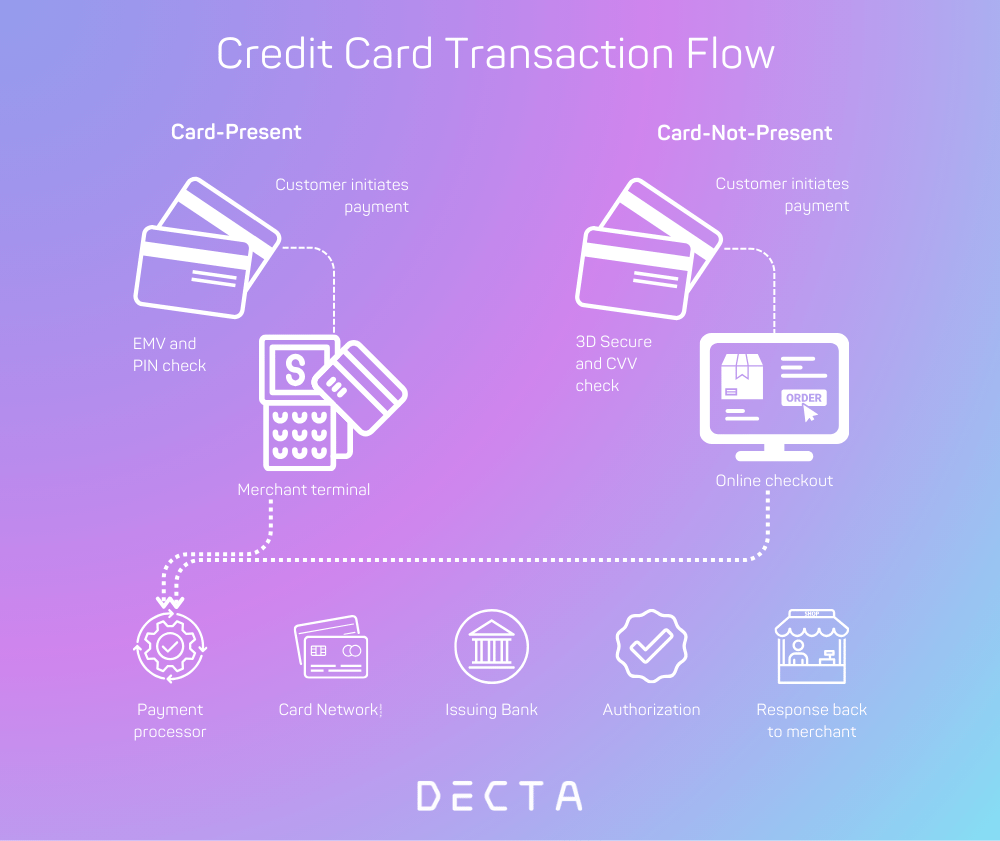
Credit card processing is one of the most widely used payment methods for making transactions worldwide. Every card payment involves four parties: the cardholder's issuing bank, the merchant's acquiring bank, the card network that routes the transaction between them, and the merchant, and it runs in three stages: authorization, clearing and settlement.
Credit card transactions fall into two types:
Card-present: transactions happen when a buyer physically gives a credit card to a merchant. Approval time is quicker, and fraud is less common, largely because EMV chip and PIN verification makes the physical card hard to counterfeit.
Card-not-present: in contrast, these transactions are more typical for online payments, requiring additional security on the merchants' behalf against fraudulent charges.
There are similar security measures involved with credit card processing. PCI DSS and 3D Secure aim to protect both the merchant and the consumer with cards that are not easily hackable. 3D Secure adds an issuer authentication step to card-not-present payments, and in Europe it is the main way to meet the Strong Customer Authentication (SCA) requirement of PSD2. Tokenization serves the same purpose for cardholder data being switched with a useless token out of context.
These developments do not come free. Interchange fees and processing costs, as well as fees assessed by different card payment networks like Visa, Discover, Amex, and Mastercard, can change rapidly. Interchange is the fee the acquirer pays the issuer on each transaction, and it usually makes up the largest share of what a merchant pays to accept cards. For merchants looking to maintain a consistent pricing strategy, understanding these metrics of operation provides insight for proper pricing.
The pros and cons of credit card processing are relative to the merchants. They can add a convenience fee and enjoy an influx of customers, yet credit card processing can come at a cost with high interchange fees and processing costs passed on to the merchant.
Debit Card Processing
Debit card processing works much like credit card processing but differs in a few key ways. As one of the common types of payment methods, debit cards do not charge a line of credit; rather, they access the cardholder's bank account immediately. Therefore, chargeback options may be different, and authorizations may come from the cardholder's bank or the bank of the card issuer.
There is debit card processing through online debit transactions or offline debit transactions, meaning that how transactions are processed varies:
Online debit: the transaction involves real-time authorisation between the merchant and the cardholder's bank. Online debit is typically PIN-based and runs as a single-message transaction, so authorization and clearing happen in one step. This means that availability must be there at that moment for funds to go through. If the bank's processing is slow, it can hinder transactions.
Offline debit: in contrast, offline debit is typically signature-based and runs as a dual-message transaction through the card networks. It does not require immediate authorization and can be processed in batches, allowing for quicker transactions at checkout, yet it can lead to more declined transactions if accounts go negative in between processing.
For merchants, debit card processing is a bit cheaper than credit card processing because there are generally fewer middlemen involved. In the EEA, the Interchange Fee Regulation caps consumer debit card interchange at 0.2% of the transaction value, compared with 0.3% for consumer credit cards.
The settlement time is sometimes faster, too, which allows access to funds and cash flow sooner for merchants. Merchants need to ensure PCI DSS compliance to protect against potential fraud risks, which would otherwise negate the benefits.
Prepaid Cards & Gift Cards
Prepaid cards and gift cards are processed like any other card; however, they are a great option for consumers to have flexibility. Merchants must decide whether prepaid cards are reloadable or non-reloadable. Reloadable cards are processed as debit cards. Non-reloadable cards are gift cards, meaning consumers cannot reload the card balance once it goes to zero.
Prepaid cards and gift cards have specific fraud risks and compliance requirements. From a fraud standpoint, criminals will use them under the guise of money laundering, which creates a need for compliance requirements for regulators, issuers, and merchants.
In practice, this means anti-money laundering (AML) controls and know-your-customer (KYC) checks, with stricter verification required once load limits or balances pass the thresholds regulators set.
Bank-Based Payment Processing
Bank-based payment processing in the banking industry is still highly reliant upon processing payments with the bank itself. Payment processing methods that connect a user with a financial institution include ACH transfers and wire transfers.
ACH Transfers (Automated Clearing House)
ACH transfers, or Automated Clearing House transfers, are a widely used bank payment processing method that enables the electronic movement of money between financial institutions. As a foundational component of modern banking, ACH transfers facilitate efficient and reliable transaction processing through batch settlements.
ACH is a US network: standard transfers usually settle within one to two business days, while Same Day ACH settles faster for an additional fee. These transactions are generally categorized as either ACH credit transfers or ACH debit transfers, each with specific roles in the payment ecosystem.
An ACH debit transaction means money is pulled from a bank account, while an ACH credit transaction means money is pushed into one. For example, if you have a subscription service with a recurring payment, that is an ACH debit transaction, as it will pull funds from your account every month.
However, you should look at credits as payments in and debits as payments out. For example, if you receive your paycheck, that is an ACH credit transaction, as someone transferred funds into your bank account, as was a vendor payment to an independent contractor. This is regulated through NACHA, the organization that writes the operating rules every ACH participant must follow.
Wire Transfers
Wire transfers are a widely used method for electronically transferring funds, valued for their speed, security, and capacity to handle large sums of money. Domestic wires typically settle through a country's real-time gross settlement (RTGS) system, while international wires are usually sent over the SWIFT network and can pass through one or more correspondent banks, each of which may deduct a fee.
However, despite these benefits, wire transfers also come with challenges such as regulatory compliance requirements and potentially high transaction fees. Businesses considering bank transfers as a payment method must navigate strict financial regulations, as a damaged banking relationship can be difficult to repair. Additionally, companies are often surprised by the higher fees associated with wire transfers compared to other payment options.
Two more electronic funds transfer options are international transactions and interbank transfers. An international transaction is a general term used to discuss any time funds are sent across borders. An interbank transfer is more specific and occurs when payments are made between two financial institutions that have direct arrangements for interbank connections.
This is often the case when two companies that use different banks enter similar agreements to make payment processing easier. This could reduce wire transfer fees or ACH processing when banks link up directly.
However, they are costly. Fees depend upon transaction amount and origin/destination. Likewise, if a business wants to make an international transaction via wire transfer, it must assess its potential for fraud and currency fluctuations.
Direct Debit & SEPA Transfers (Europe)
Direct debit and SEPA transfers support payment processing needs for businesses in Europe. Direct debit and ACH transfers are similar types of electronic funds transfer, but SEPA transfers and direct debit apply to specific areas where business occurs and the compliance requirements for each transfer type.
The SEPA transfer allows businesses to make euro transactions across borders with ease; SEPA is a geographic area smaller than international, meaning it supports more euro senders and receivers within the SEPA region. There are three main SEPA schemes:
SEPA Credit Transfer: the standard push payment.
SEPA Instant Credit Transfer: delivers funds in under ten seconds around the clock.
SEPA Direct Debit: lets a business pull recurring payments from a customer's account once the customer signs a mandate.
SEPA transfers have lower transaction fees than international transactions, and payment processing speed is quicker, supporting cash flow management. Compliance requirements with SEPA regulations can be challenging to assess.
There are numerous advantages of direct debit and SEPA transfers for companies needing to manage recurring payments and those seeking operational efficiencies.
Open Banking & Account-to-Account Payments
Open banking refers to account-to-account (A2A) payments initiated through a regulated third party with the customer's consent. In Europe, PSD2 requires banks to give licensed payment initiation service providers (PISPs) API access, so a customer can authorize a bank transfer at checkout without entering card details.
For merchants, A2A payments usually cost less than card payments and settle quickly, often over instant payment rails such as SEPA Instant, but they offer no card-style chargeback rights, which shifts dispute handling to the merchant and the bank.
Digital & Alternative Payment Processing
Recent developments in digital and alternative payment processing are transforming how consumers and businesses engage in transactions. From e-wallets to Buy Now, Pay Later (BNPL) offerings, the landscape is evolving with innovative and flexible options that appeal to modern consumer behaviour.
E-Wallets (Apple Pay, Google Pay, PayPal)
E-wallets are now a mainstream option in alternative payment processing. Often categorized under mobile payment apps, they are used for mobile and online transactions and employ tokenised transactions, replacing sensitive card data with tokens. If intercepted, these tokens are useless to hackers, ensuring secure transactions.
Apple Pay and Google Pay work by storing a network token issued by Visa or Mastercard on the device instead of the card number, whereas PayPal works as a stored-value and account-based wallet that can also be funded by bank transfer.
They also feature enhanced security measures, such as device authentication to verify the transaction is initiated from the approved device, and encryption to protect all data transmitted during transactions.
For merchants, implementing an e-wallet or mobile wallet involves SDKs and APIs, integration methods that can offer a seamless payment experience when executed correctly. However, understanding their technical nuances is critical to avoid compromising customer satisfaction post-implementation.
Buy Now, Pay Later (BNPL)
Buy Now, Pay Later (BNPL) offers an alternative to credit card transactions, allowing consumers to make purchases through scheduled instalment payments. This flexible payment option simplifies transactions and aligns with modern spending habits.
As one of the emerging types of payment methods, BNPL continues to reshape how consumers approach purchasing decisions. However, merchants should account for distinct merchant fees and settlement models associated with BNPL. Providers such as Klarna, Afterpay and Affirm typically pay the merchant the full amount upfront and take on the repayment risk themselves, charging a higher merchant fee than card payments in return.
Additionally, many BNPL solutions integrate with NFC-based processing, relying on contactless payments. Understanding transaction limits and usage frequency helps evaluate whether BNPL will encourage more frequent, smaller purchases or limit consumer activity due to capped usage.
BNPL can boost customer satisfaction by supporting consumer cash flow and enabling financially manageable purchases.
Mobile Payments & NFC Transactions
Mobile payments and NFC-based processing are reshaping commerce by simplifying and accelerating transactions. Near-field communication (NFC) enables contactless payments, allowing consumers to tap a payment terminal using a mobile device or card to initiate a transaction.
This technology supports a seamless payment experience that encourages spending and accessibility. However, businesses must stay informed on contactless payment trends, including transaction limits and hardware requirements.
In Europe, for example, SCA rules allow contactless card payments of up to €50 without a PIN, after which cumulative spending or transaction-count limits trigger authentication, while phone wallets avoid most limits because the device itself verifies the user.
QR Code-Based Payments
Another effective method of offering mobile payments is through QR code-based payments, known for their affordability and broad compatibility. Understanding the difference between static QR codes (unchangeable) and dynamic QR codes (modifiable in real time) is essential for correct implementation and optimal customer satisfaction.
Static QR codes are suitable for fixed transactions, whereas dynamic ones support real-time updates, useful in settings requiring price adjustments or personalized service.
In some cases, QR codes may also be paired with payment links to streamline the checkout process, especially for remote or digital purchases of goods or services. Like NFC, cashless payment adoption rates and limits can influence which QR code method is most effective.
Payment Processing with Cryptocurrency and Blockchain-based technology is an emerging trend that has gained much attention over the years; however, Cryptocurrency and Blockchain-Based Payment Processing offer challenges and opportunities that need to be considered.
Bitcoin, Ethereum, and Stablecoin Transactions
Processing payments through Cryptocurrency is an effective way to make a financial transaction with digital currencies like Bitcoin, Ethereum, and Stablecoins. Therefore, Payment Processing differs when approaches are on-chain versus off-chain.
Factor
Where the payment occurs
Speed and cost
Trade-off
On-chain
Within the ledger of the Blockchain itself
Each transaction must be recorded in real-time, which can lead to a more extensive, expensive transaction
Recorded on the ledger
Off-chain
Outside of the Blockchain ledger
Faster processing times and reduced transaction fees
May forego security and transparency
The Bitcoin Lightning Network is the best-known example of off-chain processing: payments move instantly between parties and only the opening and closing balances are written to the blockchain.
Cryptocurrency raises concerns regarding transaction speed and volatility. Before purchases are finished, digital assets can appreciate or depreciate, meaning what was a digital asset may not be a digital asset come purchase.
Stablecoins such as USDC and USDT are pegged to a fiat currency, which is why merchants and crypto payment gateways use them, or convert to fiat at checkout, to avoid this price risk.
Merchants must adopt the challenges of Smart Contracts and Trustless Payments that allow for Decentralized Payment Processing, complicating the process.
A smart contract is code on a blockchain that releases funds automatically once agreed conditions are met, so no bank or processor sits in the middle to authorize or reverse the payment.
Merchants have concerns about Payment Processing and accuracy without pre-established contracts or transaction control; thus, it's critical to understand the technology. Merchant adoption struggles arise from having to integrate complex Decentralized Payment Processing systems and regulatory requirements.
What is Tokenization in Payments?
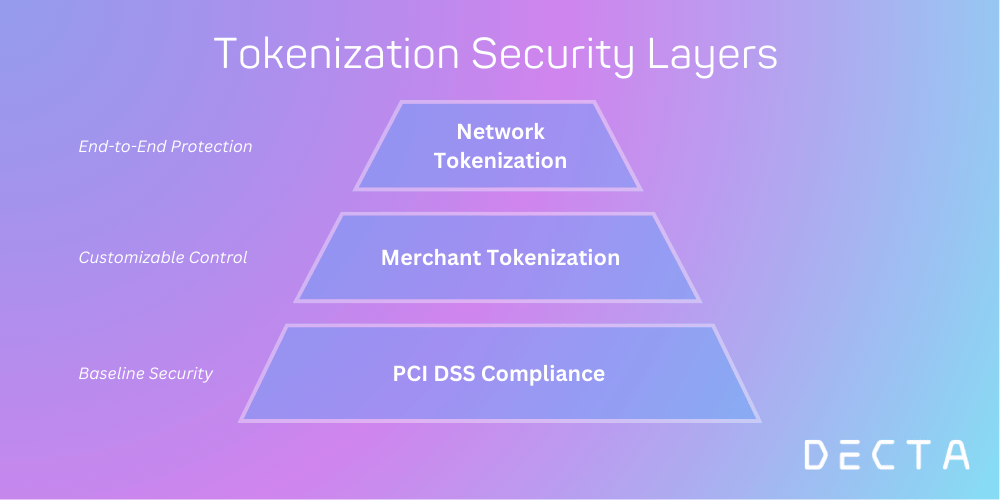
Tokenization in payments refers to a security measure designed to more effectively protect sensitive data when transactions are processed. By replacing sensitive card data with a token, the actual transaction occurs more securely while less sensitive information is vulnerable to a potential data breach. In order to leverage this security measure, however, it's important to understand network tokenization vs. merchant tokenization:
Network tokenization: occurs with most of the larger card networks: Visa, Mastercard, and Amex. A merchant does not necessarily have as much access to the inner workings, as card data is substituted for a token at the network level. Network tokens follow the EMVCo payment tokenization standard and update automatically when a card is reissued or expires, which reduces failed recurring payments and tends to raise authorization rates.
Merchant tokenization: in contrast, occurs at the merchant level, granting more flexibility and control on the business end. Because a merchant token only works within that merchant's or processor's environment, it also reduces the scope of PCI DSS compliance.
Chargebacks & Dispute Resolution Mechanisms
Chargebacks, and ways to resolve them, help assess transaction risk. Chargebacks contain many details that, when assessed appropriately, can help avoid chargebacks in the first place and minimise their impact on profitability.
When chargebacks occur, they are a way for the cardholder to dispute a transaction and initiate a reversal of funds that would have otherwise gone to the merchant. Although increasingly common as a form of consumer protection, chargebacks are a significant inconvenience for merchants as they complicate profitability and cash flow. Merchants should be aware of the causes of chargebacks and what they can do to avoid them through prevention strategies to better balance transaction risk.
Every chargeback carries a reason code, such as fraud, goods not received or a processing error, and Visa and Mastercard place merchants whose dispute or fraud ratios exceed set thresholds into monitoring programs that bring extra fees.
Dispute resolution mechanisms explain how to fight a chargeback, what forms of documentation are required, and how to submit the case to the card network. This process is called representment: the acquirer sends the merchant's evidence back to the issuer, which decides whether to reverse the chargeback.
Many merchants do not have the time or resources to figure this out, although knowing these details can reduce transaction risk and provide the ability to navigate dispute processes successfully.
Compliance & Data Security for Payment Providers
Another consideration for businesses when choosing payment processing options is compliance and data security. Knowing PCI DSS, GDPR, and important regulatory requirements helps businesses achieve compliance and data security protections.
PCI DSS: the Payment Card Industry Data Security Standard, which outlines security requirements needed by those businesses that directly handle cardholder data. PCI DSS compliance is required for businesses that accept payment processing to reduce effort on the part of the business and ensure customer safety in the event of a data breach. Version 4 of the standard (currently v4.0.1) is the one in force, and the compliance level a business must meet depends on its annual card transaction volume.
GDPR: its relation to business data security offers important security requirements for how personal data should be handled, possessing significant regulatory impact for global businesses and those interacting with Europe.
PSD2 and AML: in the EU, PSD2 adds Strong Customer Authentication for most electronic payments, and anti-money laundering rules require payment providers to verify customers and monitor transactions.