Successfully Migrating from Legacy Payment Systems to Modern Solutions

Legacy payment system migration is a staged process for payment providers, running from data audit through secure transfer, testing, and go-live monitoring. This guide covers the strategic considerations and best practices behind each step of the move to modern payment solutions.

March 29, 2025

As the digital wave continues to transform industries, payment processors, banks, and fintech companies are increasingly prioritizing payment processor migration to move away from archaic legacy systems and toward state-of-the-art payment solutions.

Embracing these modern systems not only enhances operational efficiency but also fortifies security, scalability, and customer satisfaction.

key-takeaways-icon

Key Takeaways

  • Transitioning to modern payment systems enhances scalability, security, and customer satisfaction
  • Legacy systems pose risks, including inefficiencies and compliance challenges
  • Strategic planning and comprehensive data audits are crucial for a successful migration
  • Secure data transfer and rigorous testing ensure seamless operations
  • Future-proofing your payment system is vital to accommodate emerging technologies and increased transaction volumes

Why Payment Processor Migration Matters for Payment Providers

Payment processor migration matters more than ever as businesses face growing pressure to meet evolving consumer expectations and technological advancements.

Sticking with legacy payment systems can hinder growth, introduce security and compliance risks, and create friction in the customer experience. In contrast, modern payment processors offer streamlined, secure, and scalable solutions that align with the demand for seamless transactions.

Modern payment processors bring new systems to the table that legacy payment systems cannot—scalability, enhanced security measures, and user-friendly experience. Businesses benefit from easier scaling and security adjustments as their transaction volumes grow.

Adopting enhanced security measures reduces concern for cyberattacks and customer data breaches while modern payment processors have better processing times.

Payment system modernisation is also what makes future-proofing possible. A modern platform absorbs rising transaction volumes without re-architecture, and it lets new payment methods, currencies, and regional schemes be added through configuration rather than a fresh integration project, so the next expansion does not become the next migration.

Leave Legacy Systems Behind

DECTA runs payment infrastructure built on open APIs, so the platform you move to today does not become the migration you dread tomorrow.

Get in touch

Core Challenges of Migrating Legacy Payment Systems

Migrating from legacy payment systems brings a unique set of core challenges that can put both operations and customer trust at risk if not handled with care.

From integrating with modern platforms to safeguarding data and staying compliant, businesses must navigate these hurdles while keeping disruptions—and downtime—to a minimum.

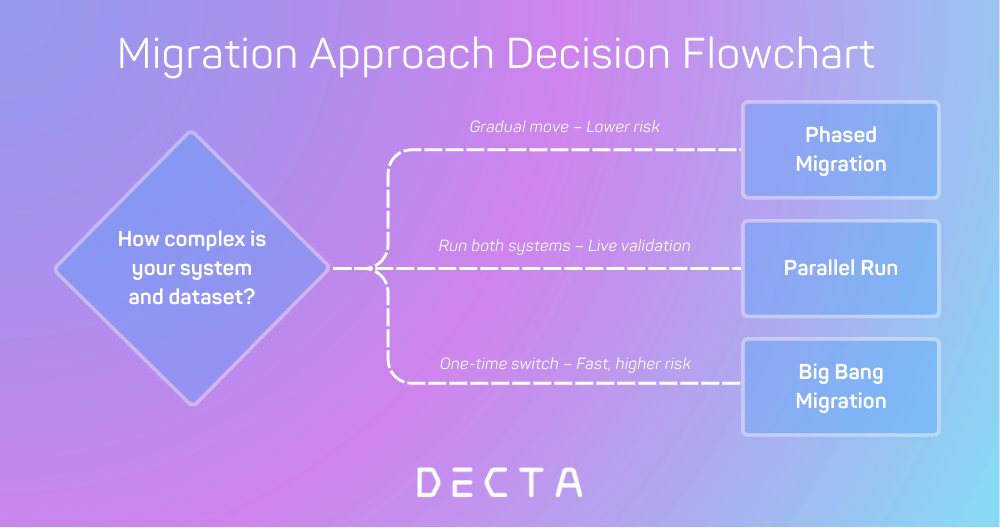
Flowchart showing three migration options: Phased Migration, Parallel Run, and Big Bang Migration, based on system size and complexity.

Legacy Payment Data Compatibility Issues

Payment and customer data from legacy payment systems may not be in proprietary formats and might require extensive data standardization with the new processor to mitigate data loss and corruption.

This means that internal audits of legacy data are an important step in order to ensure proper data migration when moving to another processor.

Compatibility work is mostly field mapping: every field in the legacy schema, from merchant IDs and currency codes to transaction statuses and stored payment credentials, has to be matched to its equivalent in the new system, and anything without an equivalent has to be transformed or archived before transfer rather than discovered mid-cutover.

Vendor Lock-In

Legacy payment providers often use proprietary tokenization methods and keeping payment data handy and accessible may be challenging, meaning that there is a great reliance on the legacy provider and payment information permanently stored. Open APIs and token portability should be sought to mitigate vendor lock-in.

Token portability: if the legacy provider's tokens cannot be exported and re-mapped to the new processor, stored card credentials do not travel, and recurring billing and one-click checkout break until customers re-enter their card details.

Open APIs: these matter for the same reason in reverse — a platform whose data and integrations stay accessible is one you can leave again later, which is what keeps the new system from becoming the next legacy system.

Compliance Risks

PCI DSS, GDPR, and other regulatory guidelines may be red flags raised when switching processors, especially when the legacy requirements do not maintain compliance with any known rules. Auditing legacy security practices prior to switching can ensure sustainability without compliance risks later down the road.

PCI DSS: governs how cardholder data is stored, transmitted, and protected, so the transfer method itself falls inside its scope, not just the destination system.

GDPR: governs the customer data attached to those transactions, which makes data retention, deletion, and the legal basis for moving records part of the migration plan rather than a post-launch clean-up task.

Operational Downtime

Shortcomings in payments inevitably cause gaps in revenue and frustrate customers, so decreased uptime is not an option.

Phased migrations or parallel runs help reduce operational downtime, so full transitions are not necessary on legacy systems while testing happens—those options allow for execution without fully turning off the existing payment processing system.

Where a hard switch is unavoidable, the cutover window should be scheduled around the lowest-traffic period in the transaction history and communicated to merchants in advance, so any pause in authorisations is short, expected, and covered by a rollback path.

Payment Data Integrity Concerns

Migration problems are compounded with payment systems if data is incorrect or inconsistent, such as duplicate or missing payment transactions.

Extensive validation checks before and after the migration help avoid reconciliation issues that would otherwise complicate results weeks later.

Preparing for a Legacy Payment Platform Migration

Migration preparations and strategic planning lay the foundation for a smooth transition from legacy payment systems to modern solutions.

Taking time to anticipate potential challenges and map out key steps in advance can make all the difference in ensuring the process runs efficiently and delivers the intended results.

1. Comprehensive Data Audit

Compiling a comprehensive data audit will help companies assess their current payment data and any data inconsistencies or data redundancies that exist. A comprehensive data audit may provide companies with insight into the efficacy of their data management practices while assessing which pieces of information are unnecessary or ineffective.

A proper comprehensive data audit will ultimately help create data standardisation that assists with compliance under the new system and avoids data loss or data corruption during the migration process.

Compiling a comprehensive data audit also reveals potential problems that companies may be unaware of. When they discover these problems early enough, they can deduplicate or refine their efforts to better manage proper data collection before moving to the new payment system.

2. Choosing the Right Migration Approach: Phased, Big Bang, or Parallel Run

There are three major migration approaches that a company could choose from at this step of the process. Phased migration is the most common as it allows companies to gradually move to the new system in a measured approach that reduces risk and enables testing of the new system's capabilities.

The second is a big bang migration, which allows companies to start fresh with the new system but only works for smaller datasets or needs with a compressed timeframe. The third opportunity is a parallel run, which enables both systems to run simultaneously for troubleshooting and real-time validation in real-time.

Each option has its advantages and disadvantages which should be weighed against the company's needs. The trade-off is between speed and reversibility:

Approach
Phased migration
Big bang migration
Parallel run
Best suited for
Gradually moving to the new system in a measured approach
Smaller datasets or needs with a compressed timeframe
Troubleshooting and real-time validation
Trade-off
Limits how much traffic is exposed at any point
Finishes fastest but leaves rollback as the only recovery route
Costs the most to operate because two systems process the same volume at once, but makes every discrepancy visible before the legacy system is switched off

Secure Data Transfer Without Disruption

Secure data transfer is essential during the payment data migration process. Businesses must take steps to reduce risks so that sensitive information remains private when moving data.

Minimizing Risks During Data Transfer

One way to secure data transfer is to use secure ETL to ensure all data moves smoothly from step to step during the payment migration.

ETL stands for extract, transform, load: records are pulled from the legacy system, reshaped into the new processor's format, and written into it, and because the transform stage is where duplicates, truncated fields, and mismatched currency or status values are introduced, it is the stage that decides whether the transferred data reconciles later.

Businesses can also rely on encryption at all times to ensure that payment data remains private even while it's being moved. Encryption in transit matters most during the transfer window, which is the period when payment records sit outside the controls of both the legacy system and the new one and are at their most exposed.

Data breaches are all too common, and with so much at stake with sensitive customer information, the last thing any business wants is a failed migration to a new payment processor.

Backup and Contingency Planning

Backup and recovery is another critical part of a successful migration process. Before integration even starts, businesses need to back up essential data for current payments just in case there are any mistakes made along the way that jeopardize current credit card transactions or customer payment information.

Another step is creating a rollback plan, which ensures that businesses know how to quickly fix a situation in case of migration failure and downtime is reduced.

A rollback plan is only useful if it is specific: which system resumes authorisations, who makes the call, at what error rate, and how transactions processed on the new platform in the meantime are reconciled back.

Grid showing six key migration risks: data compatibility, vendor lock-in, compliance gaps, operational downtime, data integrity issues, and security weaknesses.

Minimizing Risks During Data Transfer

One way to secure data transfer is to use secure ETL to ensure all data moves smoothly from step to step during the payment migration. Businesses can also rely on encryption at all times to ensure that payment data remains private even while it's being moved.

Data breaches are all too common, and with so much at stake with sensitive customer information, the last thing any business wants is a failed migration to a new payment processor. Thus, many steps must be taken to ensure a secure data transfer process, which ultimately protects the company from complications in the future. If customers are unhappy, they'll leave—and businesses cannot let that happen.

Backup and Contingency Planning

Backup and recovery is another critical part of a successful migration process. Before integration even starts, businesses need to back up essential data for current payments just in case there are any mistakes made along the way that jeopardize current credit card transactions or customer payment information. Backup serves as a fail-safe for businesses that need to put everything back in place.

Another consideration is creating a rollback plan, which ensures that businesses know how to quickly fix a situation in case of migration failure and downtime is reduced. Contingency planning increases resilience and allows for a successful transition to the payment processor.

The Payment Data Migration Process, Step by Step

When moving to a new system, there's a lot more to the data migration process than simply transferring information.

Each step plays a vital role, especially testing and validation, which help confirm that everything works smoothly on the other side and that the system meets the needs it was meant to serve.

Linear diagram showing five steps of secure data transfer: Extract, Encrypt, Transfer, Validate, and Store Safely.

Pre-Migration Testing

Pre-migration testing involves simulating real-world payment scenarios to identify potential issues before the migration begins. This testing process allows businesses to validate transaction success rates and ensure accurate reconciliation, reducing the risk of errors during migration.

Sandbox testing is where those scenarios run, using a copy of the migrated data rather than live traffic, so authorisations, refunds, chargebacks, and recurring payments can each be checked against expected outcomes before a single real transaction touches the new system.

By conducting thorough pre-migration testing, businesses can identify and address potential challenges before they impact operations.

Go-Live Monitoring

Go-live monitoring is a crucial step in the migration process, allowing businesses to closely monitor transaction flows during the initial phase of the new system's operation.

This monitoring process enables businesses to quickly identify and address errors, such as failed transactions or reconciliation mismatches, ensuring that operations continue smoothly.

The metrics worth watching in the first hours are:

  • Authorisation success rate
  • Decline reasons
  • Settlement timing
  • Duplicate transaction counts

All of them compared against the legacy system's normal baseline rather than judged in isolation.

By prioritising go-live monitoring, businesses can enhance their ability to respond to potential issues and maintain service continuity.

Post-Migration Reconciliation and Legacy Decommissioning

Reconciliation is the check that proves nothing was lost in transfer: transaction counts, balances, and settlement totals from the legacy system are matched line by line against the new one, and any gap is traced before it reaches a financial report or a merchant statement.

Only once reconciliation is clean should the legacy system be decommissioned, and even then the records it holds usually have to be retained in read-only form to satisfy PCI DSS and GDPR retention obligations, along with dispute and chargeback windows that can stay open for months after the switch.

Plan Your Migration With DECTA

DECTA works through data audits, cutover planning, testing, and go-live monitoring with payment providers leaving legacy systems behind.

Talk to DECTA