How Issuer Processing Works: Behind the Scenes of Card Transactions
This article walks through how issuer processing works step by step, from the moment a transaction is initiated to the moment it posts to a cardholder's account, and what to look for when choosing an issuer processor.
April 01, 2025
Issuer processing turns a card tap into an approved, settled transaction, and understanding that sequence is crucial for fintech and payments professionals at banks, fintechs, and card issuers. Behind every card swipe lies a complex network of operations ensuring that transactions are processed smoothly, securely, and swiftly.
Key Takeaways
Issuer Processing is a critical component in the payment ecosystem, distinct from payment processors and gateways.
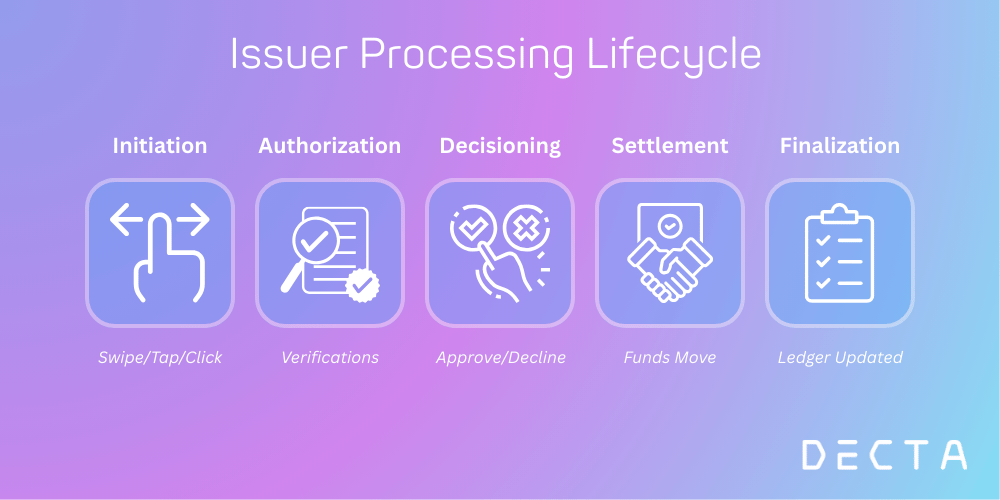
The step-by-step process involves transaction initiation, authorisation, approval or decline, settlement, and posting.
Issuer Processors manage security, compliance, card issuance, and transaction monitoring.
Understanding issuer processing is vital for banks and businesses to enhance speed, security, and cost-efficiency
Selecting the right issuer processor hinges on factors like speed, security, compliance, scalability, and cost.
What is Issuer Processing in Payment Transactions?
Issuer processing refers to the role played by an issuer processor in managing the authorization, clearing, and settlement of payment transactions on behalf of a card issuer, such as a bank or fintech company.
The process ensures that electronic payments, whether made via credit, debit, prepaid, or virtual cards, are handled securely and efficiently.
The issuer processor focuses specifically on the transacting facilitation of the issuer bank, including transaction approval, fraud detection, merchant review and regulation.
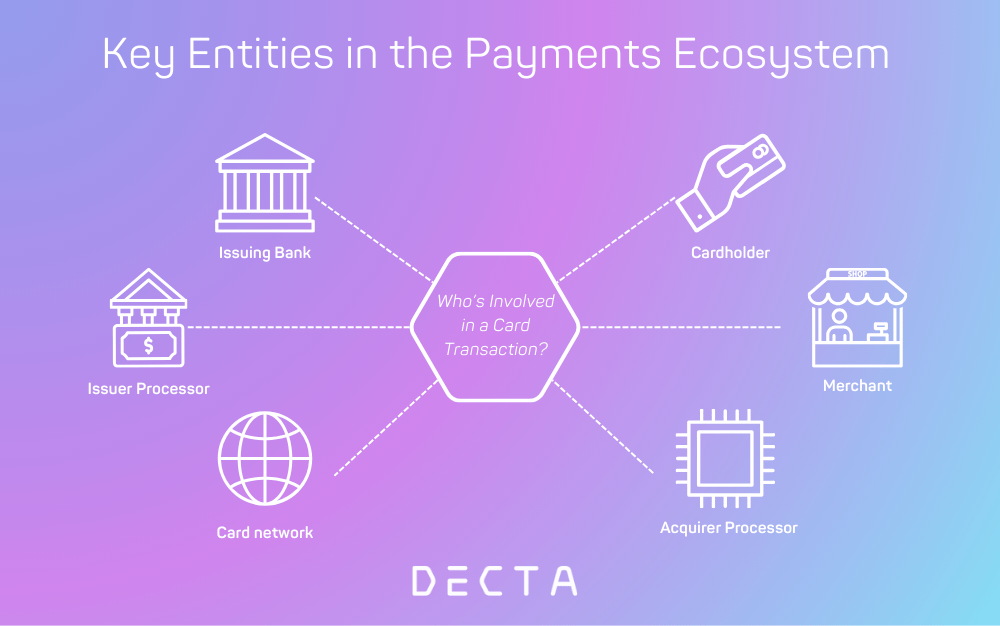
Card issuer processing creates a network among various entities, such as the issuing banks and card associations (i.e., Visa, Mastercard, UnionPay).
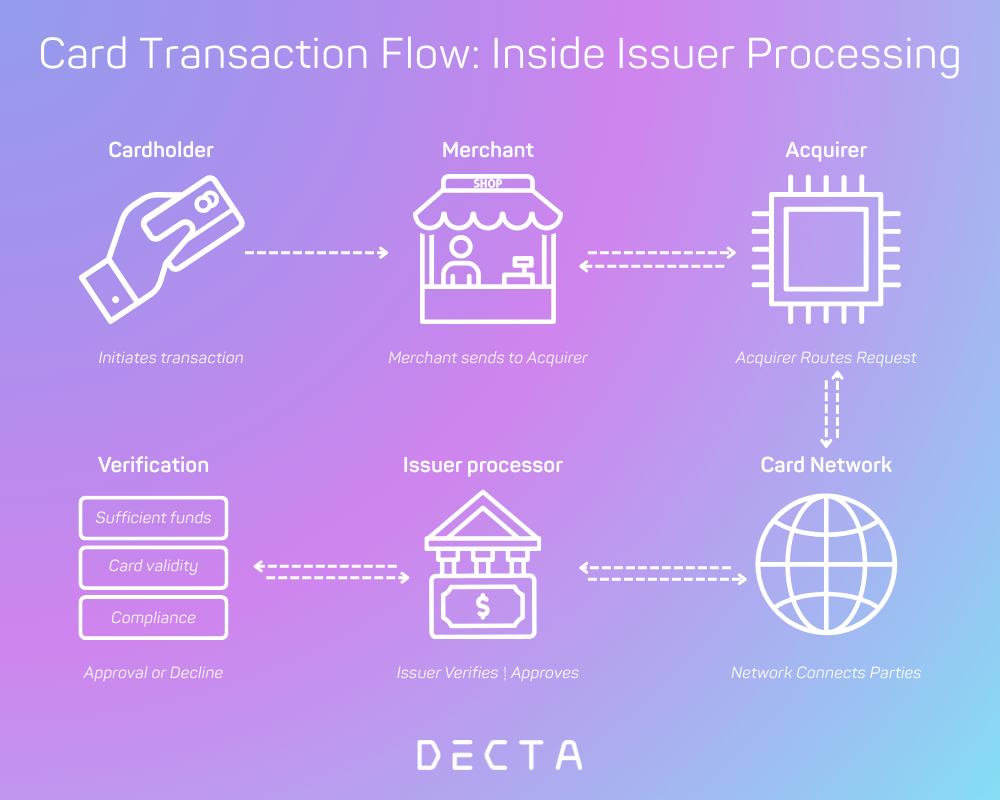
When a consumer swipes a card, the issuer processor connects with the issuing bank to either accept or decline the charge. Simultaneously, it connects with acquirers (on the merchant side) and card associations to settle the charge through the payment waterfall.
How that connection is built matters in practice. Authorization messages travel either over ISO 8583, the long-standing message standard used for authorization switching between issuers and networks, or over a modern REST issuing API.
The distinction determines how quickly an issuer can launch and how easily it can automate card management on top of the processing layer.
Where cardholder balances sit is the other structural choice:
Balances inside the processor: card and account management stay in one system.
Balances outside the processor: they sit in the issuer's own core banking system, and the processor integrates with that core to check funds at authorization.
Both models support the same transaction flow, but they change the integration work and where reconciliation happens.
For complete payment processing, three things need to be in place:
A connection to the card network, with the payment processor serving as the business' link to the card network
Communication pathways from merchant to card network
An online payment gateway for money transmission and data transmission from merchant to consumer
Run Your Card Programme on Certified Processing
DECTA handles authorisation, clearing, settlement, 3D Secure, and card lifecycle management for banks and fintechs issuing Mastercard, Visa, and UnionPay cards.
Issuer Processor vs Acquirer Processor: Where Each One Sits
The distinction between issuer processors and acquirer processors lies in the roles they play within the payment ecosystem, and in where each one sits in the transaction process. Issuer processors work on behalf of issuing banks, serving cardholders, while acquirer processors operate on behalf of acquiring banks, serving merchants.
Issuer processors are primarily involved during the authorization stage of a transaction. They assess whether a cardholder has sufficient funds and respond with either transaction approval or transaction decline.
Their responsibilities also include managing cardholder-related risks and preventing fraud during the transaction process.
In contrast, acquirer processors handle the initial input of transaction data from merchants and facilitate the final output required for settlement processes. They focus on verifying transaction validity and supporting chargeback prevention to minimize losses for merchants.
While both serve as technical intermediaries, the order of steps differs. Issuer processors receive transaction requests and make authorization decisions, whereas acquirer processors first transmit those requests and then receive the corresponding responses.
Many institutions need both sides. A bank that issues cards and also signs merchants runs an issuing programme and an acquiring programme in parallel, often on the same processing platform, which is why processors are commonly evaluated on their ability to cover issuing and acquiring together.
How Issuer Processing Works Step by Step
The methodical sequence of issuer processing within payment networks demonstrates how each procedural step contributes to transaction completion and network security. Each step relies on specific technological attributes to process transactions effectively, and each one has to complete before the next can begin.
Step 1: Transaction Initiation
The payment processing sequence starts when a cardholder initiates a transaction, whether at a physical POS terminal, through an eCommerce platform, or via mobile wallet technology. Regardless of how the transaction occurs, the merchant possesses all the requisite transaction data and transmits it to their acquiring partner.
The acquirer, as the merchant's bank, subsequently passes the transaction data to the appropriate card network.
At this point the transaction process is officially underway, with three pieces of information captured:
Transaction amount
Merchant details
Tokenized cardholder data
Tokenization replaces the card number with a surrogate value, which is what allows a card stored in Apple Pay, Google Pay, or Samsung Pay to be charged without the real card number ever reaching the merchant. For the issuer, provisioning those tokens through Mastercard MDES or Visa VTS is a prerequisite before wallet transactions can reach the authorization step at all.
The acquirer contains all necessary information to route the transaction request to the issuer processor via appropriate network channels. Only after this occurs can a transaction be completely authorized.
Step 2: Transaction Authorization
The authorization step begins once the issuer processor receives the transaction request, triggering multiple simultaneous verification protocols. The processor participates in cardholder authentication, legitimate transaction creation, and transaction risk verification, while also checking card status, looking for limit overages, and applying machine learning for real-time fraud flagging and transaction risk scoring.
Issuer processors rely upon multiple fraud detection programs to remain compliant with necessary regulations such as PCI DSS and PSD2. This layered approval approach protects against data breaches before the transaction is allowed to proceed.
For eCommerce transactions in Europe, PSD2 adds Strong Customer Authentication (SCA) on top of the fraud checks. SCA is delivered through 3D Secure 2, which passes device and transaction data to the issuer so it can decide whether to approve silently or challenge the cardholder.
Where a challenge is needed, out-of-band authentication sends the approval to the cardholder's banking app for a biometric confirmation. Issuers can also apply SCA exemptions on low-risk transactions, which keeps checkout friction down without breaking compliance.
Step 3: Transaction Decisioning
The decision framework activates next, once all transaction data coalesces, enabling the issuer processor to render approval or denial verdicts based on multifaceted assessment protocols:
Internal system rules
Transaction validity verification
Account viability confirmation
Available funds evaluation
When a transaction is cleared, the issuer processor relays approval to the cardholder.
Declines occasionally occur due to insufficient funds, potential fraud detection, expired or blocked card status, or system issues.
Declined payment requests inform cardholders and merchants that they need to address the situation, either by disputing the purchase with their bank or changing their payment method, allowing users to make informed choices.
Step 4: Transaction Settlement
Settlement follows once approved transactions advance to the finalization phase, orchestrating the systematic transfer of funds from buyers' bank accounts to sellers' financial repositories. Card networks manage the clearing and settlement phases by acknowledging transaction data receipt and ensuring expected funds are properly deposited into designated accounts.
The settlement step represents the final phase of a merchant's financial transaction to guarantee expected revenue. Here, card networks provide the assurances required to move money between institutions.
Clearing and settlement are often used interchangeably, but they are separate stages.
Clearing: the exchange and reconciliation of transaction records between the network and the issuer.
Settlement: the actual movement of funds that follows.
An issuer processor handles both, along with the fee calculation attached to each clearing file.
Step 5: Transaction Finalization
The last step in the process is the systematic posting of transaction data to the cardholder's account ledger, creating a definitive record of the completed financial activity. After the issuer processor settles the transaction, it posts to the cardholder's account, adding the settled transaction to their history and crediting or debiting the account as necessary.
This ensures all transactions maintain a complete audit trail and all balances remain accurate.
Card networks participate in this final stage as well, ensuring all parties in the payment processing network have proper, corresponding transactions in their records.
What an Issuer Processor Does Beyond the Transaction Flow
Alongside the transaction flow itself, issuer processors take on four responsibilities that run in parallel with it and make secure, compliant processing possible.
Transaction Security
Issuer processors empower enterprise-level security features such as encryption and tokenization solutions to protect cardholder data. An issuer processor tracks every transaction in real time, and through anomaly and activity detection, it not only alerts users but also stops fraudulent activity before it occurs.
These are compliant with international security regulations like PCI DSS, EMV, and PSD2, so the processing is done in legally appropriate environments.
Regulatory Compliance
Issuer processors ensure all transactions adhere to international security regulations, implementing comprehensive compliance frameworks that protect both financial institutions and their customers.
Card Lifecycle Management
The issuer processors manage the card from start to finish: ordering, dispatching, activating, blocking, and replacing plastic and virtual cards.
In practice this runs through an issuing API that lets the issuer set spending limits, transfer funds, check balances, reset PIN counters, and provision tokens, which is what makes 24/7 automated card servicing possible without manual back-office work.
Physical cards add a personalization bureau to the chain, where card data is sent for production and delivery.
Dispute Resolution
Issuer processing creates a universal experience for disputes and chargebacks for everyone involved, which reduces arbitrary at-risk exposure to loss for the bank and cardholder, maintains program viability, and gives cardholders peace of mind throughout all stages of the transaction.
A chargeback is a cardholder-initiated reversal of a settled transaction, and the issuer processor administers it against the card scheme's dispute rules and deadlines, exchanging evidence with the acquirer until the case is resolved.
Why Issuer Processing is Critical for Banks and Fintechs
Issuer payment processing gives banks and their merchant partners critical strategic advantages that secure payment systems and operations:
Faster Transaction Processing: Since the issuer processor is the last link in the chain for authorization, payment transactions are processed quicker and glitch-free, protecting revenue and reducing failed transactions.
Enhanced Security Protocols: Immediate transaction notifications and fraud prevention processing add layers of security for card users and issuers alike, enhancing confidence throughout the network.
Global Adoption Enhancement: Accepting almost all global currencies and different types of payments enables marketplace growth and international efforts with consistent processing quality from anywhere expenses are incurred.
Expense Reduction Efficiencies: Automated features reduce the need for human engagement while providing efficiencies of expense distribution throughout the payment processing network.
Elite processors boast authorization times below 200 ms and 99.99% uptime, and this level of efficiency equates to loyal customers and increased revenue.
If processing lag happens for seconds, transactions will leave on quantifiable levels.
Choosing the Right Issuer Processor
Transaction Processing Capabilities
Where elite processors deliver authorization times below 200 ms and 99.99% uptime, this performance directly translates to customer loyalty and revenue.
Even seconds of processing lag can result in quantifiable transaction abandonment.
Security Architecture
Elite processors render elite security features from layered securities to encryption, tokenization, and AI fraud detection.
Don't merely hold the processor accountable for where it's at now; ask about prospective upgrades to protect it from fraud in the future.
Regulatory Framework
Consider compliance as part of strategic risk. The tier one processors are always evaluating compliance shifts across international markets.
They're going to safeguard your operation from unexpected compliance changes that can shut you down overnight.
Scalability and Integration
Processing capabilities and network support transaction surges and growth. An extensive library of APIs encourages development and provides needed integration through requirements vital to custom-fit businesses.
Integration scope is worth checking early. Connecting the processor to an existing core banking system, to a personalization bureau, and to wallet token services are separate workstreams, and a processor that covers them in one contract shortens the launch.
Licensing Route
Running a card programme requires a BIN, and a BIN requires principal or affiliate membership of Visa or Mastercard.
Institutions that do not hold that membership can launch under BIN sponsorship instead, with the sponsor acting as the licensed issuer while the institution owns the brand and the customer relationship.
Whether a processor can also act as BIN sponsor decides how much of the scheme membership process an issuer has to complete before going live.
Economic Structure
Integration fees, savings, and efficiencies exist beyond basic payment processing.
A comprehensive cost analysis would render obvious cost advantages elsewhere, but focused on basic cost comparison, these strategic advantages would be lost.
This is a long-term decision that impacts customer engagement with the firm, all internal operations on a day-to-day basis, and the ability to adjust to competitive marketplace changes.
The Future of Issuer Processing
AI and blockchain have now become standard expectations within modern payment infrastructure, and new payment channels, particularly real-time payments with cross-border capabilities, have moved from emerging features to baseline requirements.
AI-Driven Risk Management
As artificial intelligence and machine learning have become deeply embedded in issuer infrastructure, fraud prevention has shifted from reactive to predictive.
Issuers now rely on predictive analytics that detect erratic transaction activity in mere milliseconds, reducing fraud loss while simultaneously protecting authentic transactions from false declines.
Blockchain Implementation
Blockchain creates transaction verification systems that act as a permanent, unalterable record as well as a broader security force.
For example, payment systems and digital identity systems are less prone to identity theft because they operate on a blockchain system and are easier to verify.
Real-Time Settlement
When real-time transaction settlement occurs, it happens instantaneously instead of over a matter of days; systems need to be overhauled from the ground up to operate correctly to ensure the accuracy at that speed of transactions per second (TPS).
Embedded Finance Integration
Banking-as-a-service (BaaS) creates a scenario where transaction processors become more than just that; they become issuance infrastructure that non-financial brands plug into to offer cards under their own name.
The communication vehicles established via APIs allow for what was never considered a financial transaction to become one via new avenues for distribution and monetization via verticals.
Implementation Requirements
To successfully implement, one needs:
A payment processing schema that allows for real-time routing across multiple payment rails simultaneously
Regulatory requirements to ensure that such an innovation does not impede operations with too much fine print
Partnership agreements to ensure access to elements not available within one's own company
Payment processing solutions that do end-to-end without compromise to ensure scale does not break a solution that exists in a box
Payment Infrastructure Built Around You
From acquiring to issuing and processing, DECTA configures its stack to your licence, your markets, and your existing systems.