How Safe Is Digital Banking? Security, Threats and Protection Explained
This article explains the security measures banks deploy to safeguard data and assets, the common cyber threats targeting banking apps, and the defence strategies that actually reduce your risk.
February 07, 2025
Digital banking security rests on layered bank-side controls and a handful of habits on the customer's side, and understanding both is what tells you how exposed your money actually is. Instant account access, seamless transfers, and effortless bill payments are all at the fingertips of the everyday digital banking customer. However, as reliance on online banking soars, so do security concerns.
How Banks Ensure Digital Banking Security
Banks ensure secure digital banking through a robust, multi-layered system that integrates security controls from the enterprise level down to customer interactions.
This security framework, a crucial component of the broader digital transformation journey in banking, has been in place for some time, reflecting a banking-first approach to digital services rather than a purely digital-first strategy. Banks prioritize security within the boundaries of institutional risk tolerances.
Behind the app you log into sits a digital banking platform, the core infrastructure where accounts, payments and card processing are actually run. The strength of a bank's security depends heavily on that platform and the certifications behind it, which is why regulated providers are audited against standards such as PCI DSS Level 1 and ISO 27001 before they are allowed to handle card data at all.
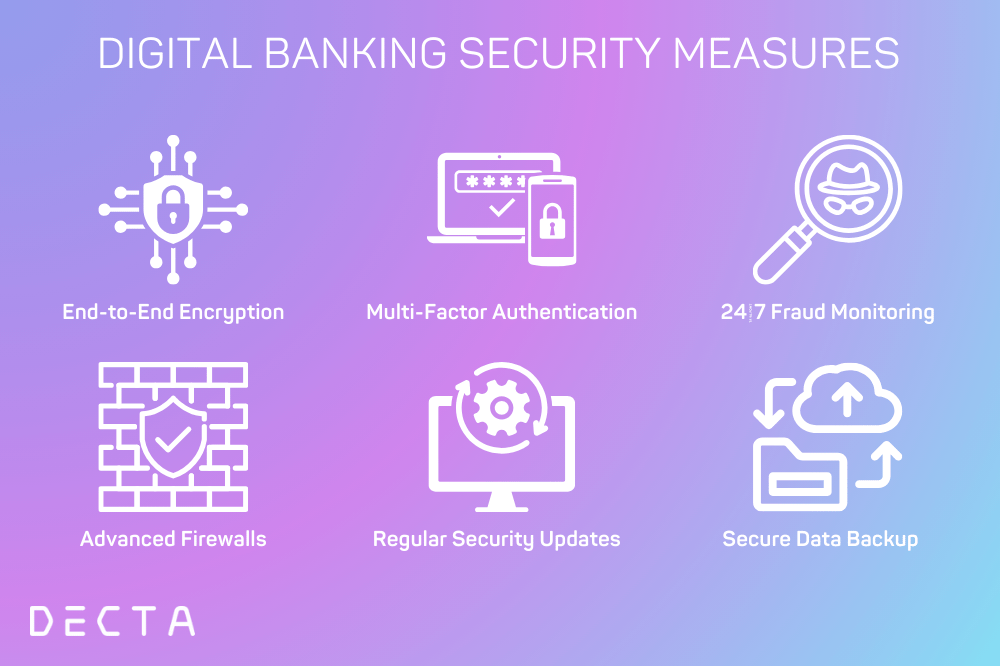
Multi-Layered Security Measures Used by Banks
The security features consist of a centralized and layered defensive control system.
For example, the perimeter security control of next-generation firewalls and intrusion prevention systems creates the perimeter access control channel, essentially a 21st-century cyber castle keeping the treasure secure from the inside out. The firewall filters malicious traffic before it reaches banking systems, while the intrusion prevention system detects and blocks attacks already in progress, so an attacker has to defeat two independent layers rather than one.
The perimeter security layer works by combining enterprise-level encryption and network segmentation, meaning that transaction routes are secured and potential intrusion routes are culled.
Segmentation matters to you as a customer because it limits how far an intruder can travel inside the bank: one breached route does not expose every account in the institution. Encryption protects your data both in transit and at rest, so intercepted traffic is useless without the keys.
Endpoint security exists at the level of user engagement with dynamic authorization and constant patching. It's like a modern-day zero-trust architecture in that anything and everything that needs to be used is constantly re-authorized.
Zero trust assumes no device or session is trustworthy by default, even inside the bank's own network, which is the reason your session times out and re-verifies rather than staying open indefinitely.
Strong Customer Authentication (SCA) and Multi-Factor Authentication (MFA)
SCA refers to a regulatory-mandated improvement to European fintech, introduced under PSD2. It establishes a common security standard across digital banking apps.
PSD2 is what obliges every EU bank to verify logins and payments with two independent factors, so the extra confirmation prompt in your banking app is a legal entitlement rather than a bank's optional extra. Therefore, it's like operating in a bank that always has a TSA checkpoint for data and privacy protection, but at the same time, every person with accessible funds constantly goes through multiple screenings to access their cash.
MFA means an authentication infrastructure consisting of static passwords, dynamic PINs from vetted single-use codes, and biometric fingerprint or retina scans. This tiered system allows for enterprise-level security without hindering cash flow opportunities.
In practice MFA is the single most effective barrier against stolen-password attacks, which is why a leaked password on its own rarely drains a digital bank account.
Card payments get a second, separate check. 3D Secure applies authentication at the moment of an online card transaction rather than at login, which is what stops a stolen card number from being used on a merchant site even if your banking credentials were never touched.
Real-Time Transaction Monitoring and Alerts
The financial industry utilizes AI-driven fraud detection systems that analyze transaction trends in real-time across similar networks, similar to the fraud detection programs that exist within credit card company networks. They analyze historical transaction behaviours on various scales to render a more and more unified assessment of risk, producing a risk score for each transaction.
Machine learning behavioural analytics work by operating like a home security system that recognizes new patterns of break-ins. Because the model learns your own normal spending profile, it can flag an unfamiliar pattern without anyone having written a rule for that specific attack in advance.
This form of technology exists as early detection of crime prevention rather than reinstatement.
Because threats and alerts are processed in real-time through the warning system with all internal communication provisions, a real-time task force is created within the department. If anything is out of sorts, automatic responses trigger while the system maintains operation, something that a live banking system today requires on the web.
Real-time transaction alerts are your half of that system: they turn the bank's detection into action you can take within minutes, before funds leave the account.
Common Cyber Threats in Digital Banking
Common cyber threats in mobile banking and web banking continue to evolve as technology advances, exposing banking sites and apps to increasingly sophisticated security breaches. The rise of Internet-based attacks and identity theft have made it crucial for users to protect their account details and login credentials while still enjoying the convenience of digital banking services. Most successful attacks target the customer rather than the bank, because account takeover through a tricked user is far cheaper than breaking encryption.
Phishing Attacks and How to Avoid Them
The largest phishing campaign in history took place from 2013 to 2015. An international phishing scheme targeted two of the world's largest technology companies, Google and Facebook. These phishing perpetrators knew a third party. They sent phishing invoices for services rendered from a company that these perpetrators knew the two behemoths were working with, and that company was real and established. Ultimately, these fraudsters received $100 million from the two companies.
Phishing is defined as fraud under the guise of your legitimate source, and it can happen to anyone. It is the most common route into a digital bank account precisely because it bypasses the bank's technology entirely and targets the person holding the credentials.
Here are the steps to prevent phishing attempts:
Don't click links, enter the URL yourself
Passwords should be strong, complicated, and different with two-factor authentication when possible
Updates for programs and operating systems should be downloaded as soon as they're available
Antivirus and anti-malware software should be downloaded from reputable sources
But keep in mind that phishing isn't a global phenomenon, and neither is vulnerability. In July 2020, the social media platform Twitter experienced a significant security breach with accounts compromised for prominent Twitter users. This breach was an example of spear phishing, the targeted variant in which the attacker researches a specific person and tailors the approach to them.
Moreover, it was directed toward Twitter employees who were more vulnerable due to remote work. The phishers posed as Twitter IT staff and reached out to employees (via email or phone) to verify credentials and obtain usernames and passwords. They not only took control of the accounts of Elon Musk, Barack Obama, and Joe Biden, but they also redirected $180,000 in Bitcoin to accounts controlled by them.
The need for phishing awareness and multi-factor authentication is on top of vulnerabilities like the Twitter hack. If even the most powerful people in the most powerful positions of tech companies are still victims of social engineering, then the relative safeguards beyond stronger social media use are not enough to keep personal information safe.
The need for phishing awareness and multi-factor authentication is on top of vulnerabilities like the Twitter hack. If even the most powerful people in the most powerful positions of tech companies are still victims of social engineering, then the relative safeguards beyond stronger social media use are not enough to keep personal information safe.
Public Wi-Fi and Man-in-the-Middle Risks
Whenever anyone accesses free Wi-Fi, especially while doing online banking, it's vulnerable. Public offerings are not often crafted with security purposes in mind, let alone a multinational corporation. Therefore, it's like an open facade where everything sent and received can be easily intercepted.
Public Wi-Fi means an unmanaged transfer similar to an ATM and a bank; your information goes where other information is going; digital thieves implement man-in-the-middle tactics to insert themselves between customers and the bank's webpage, either capturing logins upon access or during bank transactions.
The attacker sits silently in the middle of the connection, which is why the session can look completely normal to you while credentials are being harvested.
Experts say this is why one should avoid bank applications over public Wi-Fi. In addition, many bank applications these days have a connection verification option that warns the user that they are on an unsecured path. Yet when push comes to shove, and people are on the go without any other option, there are small steps people can take to maintain the integrity of the connection that will allow for an encrypted beginning and end to save all their transactions.
A VPN is the practical fallback here: it encrypts the connection end to end, so even a compromised network sees only unreadable traffic. Mobile data is the simpler alternative when no trusted network is available.
Best Practices for Secure Digital Banking
Best practices for safe online banking consist of the strategic application of fintech innovations to enhance security while maintaining seamless access and transaction efficiency. These advancements work together to create a multi-layered security framework that protects users without introducing unnecessary barriers to banking convenience.
Creating Strong and Unique Passwords
The foundations of digital banking safety rely upon password protections. Passwords are generated efficiently based upon the necessity for complexity and subsequent usefulness, randomized for security yet easily retrievable when needed on a frequent basis.
Treat your passwords like every bank is its vault, safe and secure, and never reuse passwords for any money-handling sites. A password manager works by operating like a digital bank with one-stop credential access, albeit unlocked and decoded, like a safety deposit box minus the annual safety deposit fee.
Its real value is that it makes a unique credential per site practical, which is what stops one breached shopping site from unlocking your bank account.
Enabling Two-Factor Authentication (2FA)
Two-factor authentication (2FA) adds an essential layer of protection to any digital banking experience, and it is the consumer-facing form of MFA you can switch on yourself today. 2FA provides another level of entrance aside from the protected passwords. For example, to access an account, not only is a password needed but also a generated code or a texted number. It's like needing two different keys to enter the same room, but the room won't open unless the room and keys are matched.
Many digital banking apps boast biometric authentication. Fingerprint and facial scans allow for quick and easy verification, and because they tie access to the physical user, they remove the weakest link of a memorized password. The need for such authenticated security, plus ease of access, is ideal for everyday use.
Safe Online Banking Habits
Create a banking presence that includes authentication at every step. Always access one's banking app or website to ensure access before attempting elsewhere for a third party to get into someone's bank. Always know what's expected and what's not so any red flags can be raised.
Utilize trusted devices and access through trusted connections whenever feasible. Assign specific devices for shopping and online payment so that your credit information is not jeopardized by other web browsing. Always use virus protection and security patching, think of these as tune-ups for the gears of your financial operating system.
Where your card is stored in a wallet such as Apple Pay or Google Pay, tokenization replaces the real card number with a token, so a compromised merchant never receives your actual card details.
Avoiding Suspicious Links and Unofficial Apps
Use only legitimate sites, secure apps, and licensed banking links to access anything banking. Open banking attachments only if they're sent from banks you know, but verify the sender through third-party validated sources.
The only place you're supposed to download banking apps is from legitimate sources, official app stores and bank websites, because these are the only vetted distribution channels and the download has been checked for security. Unauthorized banking apps are your security's downfall, like an intruder breaking into a previously secured vault and taking whatever it wants.
What to Do If You Fall Victim to Bank Fraud
Knowing what to do if you fall victim to bank fraud is crucial for minimizing financial loss and increasing the chances of recovery. Acting quickly and following the right steps can help protect your accounts, secure your personal information, and prevent further unauthorized transactions.
Immediate Steps to Take If You Suspect Fraud
If you see the following bank fraud activity in your bank app or online portal, here is the process to follow right away:
Check Recent Transactions: Go through your accounts and check for any transactions that are not yours and confirm they're unauthorized.
Freeze or Card Freeze: Use your banking app's card freeze function to block further use instantly, before you even reach the bank.
Fraud Alerts: Contact the three major credit reporting agencies and place a fraud alert on your accounts.
Credit Locks: Lock your credit to prevent other accounts from being opened in your name until this is sorted out.
Check Other Financial Accounts: If they're able to access this bank account, they may have access to others.
Police Reports: Depending on the situation, obtain a police report from your precinct.
Make a Log: Write down all names, numbers, and information from any correspondence.
Reset Passwords: If they have access to this bank account, they may have access to others.
Fraud is about urgency. Fraud happens, and the first step is to call a bank's fraud hotline to get someone on the line as quickly as possible, because speed of reporting is what largely determines your liability and whether you are reimbursed.
Have all personal account information on hand, days in question, and amounts in question. New passwords need to be created for compromised accounts, and an immediate freeze must be put in place to prevent further damage.
There is a fraud department at banks; there is customer service routing to get to this department, usually a twenty-four-hour-a-day, seven-days-a-week operation, and getting on the phone at the earliest possible moment minimizes your potential for damage and facilitates processing the steps to deal with the situation.
How Banks Handle Fraud Cases and Chargebacks
Involvement occurs after it has already happened, with a bank's fraud team alerted and an investigative process to determine legitimacy and fault. The time frame typically overlaps from days to weeks, with a day allowance based on severity.
Where an unauthorized card transaction is involved, the reversal runs through the chargeback process, the formal scheme mechanism by which the payment is disputed and pulled back from the merchant.
The determination may require additional client documentation like police reports or affidavits. However, adhering to the requirements gives the incident the chance for the highest level of resolution.
Yet, while investigations are still underway, many banks offer provisional credit to customers to preempt unnecessary hassles, which limits the cash flow damage while the case is open.
When the determination is that fraudulent activity did, in fact, occur, banks, in the majority, take responsibility for the breach, and credit is reissued to the customer, giving bankholders peace of mind. The only time this credit is not reissued is in the rarest of cases, making it important to pay attention to your account disclosure agreements. Disputed charges can be disputed via credit reports.
Monitoring Bank Statements for Suspicious Activity
Bank fraud is here to stay, but with a detection and prevention system, you're at least on the right track. One essential part of your lifestyle should be checking all statements.
If you have physical statements, these should be checked at least monthly; online, you should be checking, once everything is online, at least weekly.
In addition to ensuring payments were meant to be made (and to whom they're supposed) and not duplicate charges, take an inventory based upon where purchased and who purchased it and see if anything seems amiss. If you have a charge of a dollar, figure it out.
Someone may be testing a stolen credit card to see if it works before a bigger purchase, a common precursor to full account takeover.
Many banking apps automatically alert you in real-time to what is going on in your account but try to use the banking practices that come as alerts to keep you more informed. If you ever notice something amiss, get in touch with your bank right away. There's also a window of time for many banks to get you on record before they hand you any other type of consumer recourse.
Final Thoughts: Is Digital Banking Safe?
Yes, digital banking is safe. But like any safe financial transaction, one that banks rely upon to take appropriate security measures and one that people must be careful about, it's good to be on the careful, proactive end of the user experiences, for one never knows when something might go awry.
Recap of Key Security Measures
When evaluating how safe digital banking is, safety precautions implemented by banking companies include:
Encryption: Safeguarding data in transit and at rest
Multi-factor authentication: Verifying user identities through multiple channels
Fraud detection AI: Leveraging machine learning to identify suspicious patterns
Regulatory compliance: Adhering to PSD2, PCI DSS and other industry standards
End-to-End Payment Infrastructure
DECTA covers acquiring, issuing and processing under licenses issued by regulators in the UK, Ireland and Cyprus.