Top 5 CX Trends Defining Digital Banking in 2026
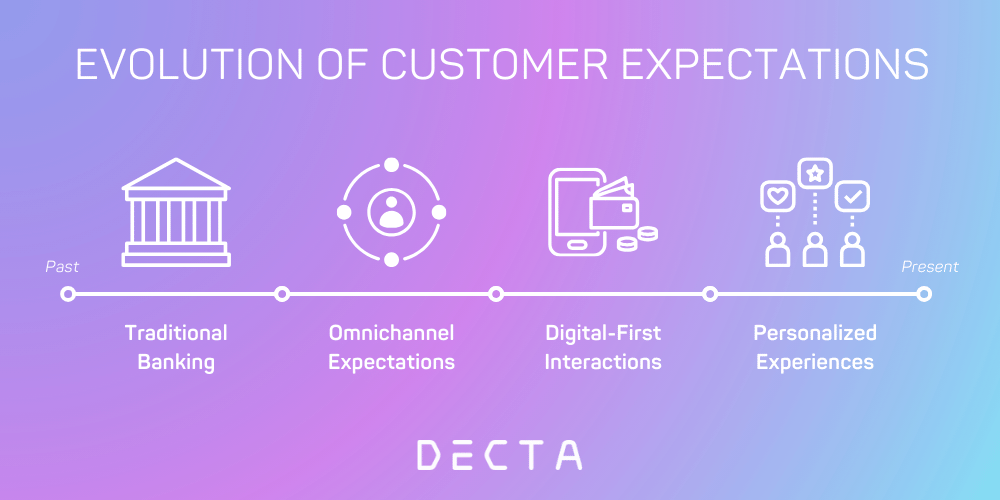
A few new trends will emerge to change the digital banking customer experience in 2026. Some come from new technology and some come from customer changes. Regardless, they present new opportunities, and new hurdles, for banking.
1. Mobile-First Communication, Wallets, and Authentication
This trend means communication and services will be dependent upon mobile.
As customers increasingly interact with banks through mobile devices, banks will need to ensure their services are optimized for mobile-first interactions.
From account management to customer support, the demand for seamless, on-the-go accessibility highlights a key shift in the mobile banking experience.
Mobile wallets are part of that expectation. Apple Pay, Google Pay, and Samsung Pay work through card tokenization, which replaces the real card number with a token so the card can be used in-store and in-app without exposing cardholder data. A bank whose cards cannot be provisioned into a wallet loses the payment moment to a competitor's card, which makes tokenization a customer experience question as much as a security one.
Biometric authentication solves the other half of the problem. Face and fingerprint checks, delivered in-app or out-of-band, let a bank verify a customer in seconds instead of asking for a one-time passcode, which keeps the mobile flow fast without loosening security.
2. Enhancing Personalized Experiences Through AI
As customer experience trends evolve, banking and personalization increasingly rely on artificially intelligent (AI) capabilities. Financial institutions are using AI to assess customers' data and provide personalized experiences, from tailored product recommendations to targeted marketing strategies.
This AI-driven personalization not only enhances the customer experience but also strengthens brand loyalty by making customers feel valued and understood.
AI is transforming personalization in the customer experience. For example, through predictive analytics, an AI-enhanced service may possess the knowledge of a banking client seeking assistance before sending an inquiry, and it may suggest a tailored product recommendation and customized financial advice before the discussion even begins.
Generative AI has extended this further, powering in-app assistants that answer account questions in plain language and draft financial summaries. Because these systems act on customer money and data, European supervisors treat them as a model risk and an explainability question, not just a product feature, so banks deploying them need a governance trail alongside the interface.
AI analytics will enable banks to change small details for a more personalized experience, leading to satisfaction and retention. This will be truer as more banks partner with clients over time and as the banking sector becomes more familiar with AI integration.
3. Real-Time Customer Service with Chatbots and Live Support
Real-time customer service has emerged as a significant digital banking experience trend.
AI chatbots, as virtual assistants operating around the clock, provide instant access to services, reducing average wait times and enhancing response times.
These chatbots handle frequently asked questions efficiently, allowing human agents to focus on complex issues, striking a balance that defines modern customer experience expectations.
However, where chatbot access is beneficial, access to a live person is still required. When sensitive or complicated issues arise with a bank, people want to talk to someone.
Therefore, many banks integrate this access with a chatbot but maintain a stable staffing of human agents who, when required, work with customers one-on-one.
4. Hyper-Personalization and Data-Driven Insights
Hyper-personalization is one of the leading customer experience trends in digital banking today. By leveraging big data and predictive analytics, financial institutions can deliver deeply customized customer experiences that make individuals feel more than just a number.
The difference from traditional customer segmentation is granularity: segmentation groups thousands of customers into a handful of personas, while hyper-personalization treats each customer's own transaction history as the segment, which is only possible once transaction data is available in real time.
This data-driven approach not only fosters stronger relationships but also significantly enhances customer satisfaction, as tailored solutions resonate with individual needs and preferences.
The possibility of fostering an emotional connection allows for the bank to be in an advantageous position with the customer. There are tons of competitive interactions and tons of informational logs of interest, but a customer who feels appreciated from a humanized interaction is more likely to appreciate the bank in return, offering continuous loyalty and word-of-mouth referrals.
5. Emotional Connections in Digital Banking Through Human-Centric Design
In simple terms, human-centered design is the future. Anything that can be done to support human feelings and an empathetic sensibility, while ensuring everything is as accessible and inclusive as possible, is the way to go.
This approach has become essential for digital banks looking to enhance customer satisfaction and create a deeper, more emotional connection between banks and consumers.
One of the core goals of modern digital banking is to reduce the time and friction in customer transactions, from the moment a product is selected online to completing the payment process.
Authentication is where that friction concentrates. Strong Customer Authentication under PSD2 requires banks to verify the customer at checkout and login, and 3D Secure 2.x is the protocol that delivers it. Its risk-based exemptions let low-risk payments through without an extra step, so a well-configured setup removes friction for most customers while keeping the bank compliant.