SLA Management for Acquirer Processing: Key Performance Metrics
An acquirer processing SLA defines the key performance metrics payment providers use to hold processing to high service standards. Learn which metrics matter, the industry benchmarks to aim for, and the best practices that drive reliability, efficiency, and customer satisfaction.
June 19, 2025
Acquiring banks, Payment Service Provider (PSP), and merchant service provider are presented with daily challenges that determine whether or not payment processing will work. SLA management is one of the more promising ways to measure, monitor and improve acquirer processing performance with customer-facing outcomes.
But what does it mean to manage SLA (Service Level Agreement) properly, and how can a good understanding of these key performance metrics improve processing and customer satisfaction?
What Makes SLA Management Critical in Payment Processing?
The financial services world is all about trust and reliability in processing and timeliness. A service level agreement for payment processing (SLA) provides both by defining expectations and making them measurable.
Processing a transaction in a timely manner provides better customer satisfaction and loyalty. If a customer wants to buy something, they shouldn't have to wait for a transaction to go through.
Acquiring banks can avoid chargeback rate when an acquiring SLA stipulates the performance accuracy expected and required since most complaints stem from intervention errors. The faster and more efficiently processors can get a transaction done correctly with no issues, the fewer complaints they receive. Not only does this lower operational costs, but it increases revenue maximization for everyone involved, from the financial institution to the merchant to the Payment Service Provider (PSP).
When payment processing does not happen correctly and timely, it diminishes potential relationships with merchants and the Payment Service Provider (PSP). These third-party services need consistency, and if SLA (Service Level Agreement) are unknown or not agreed upon, then stakeholder alignment anticipated from credit card transactions processed through acquiring banks will not happen.
Key Service Level Metrics for Acquirer Processing
SLA (Service Level Agreement) are only as good as the key performance metrics they measure. Key acquirer SLA metrics focus on system uptime/system availability, timely yet accurate transaction processing time, quick response time for support for critical incident support, authorization rate approved vs. fraud rate attempts, error rate/chargeback rate, compliance standards/PCI DSS (Payment Card Industry Data Security Standard).
Typical performance benchmarks include 99% minimum system uptime (not including scheduled maintenance), 99% transactions occur in under 2 hours (business days), critical incident support replies within <1 hour with 24/7 support, approval of transactions need to be >95% authorization rate and the failure rates need to be <1% (chargeback rate) and <0.5% (error rate).
Settlement time occur in 1–2 business days, fraud rate attempts are <0.1%, and reporting frequency are provided to merchants consistently.
System Uptime/System Availability: 99% system uptime (excluding scheduled maintenance)
Transaction Processing Time: 99% of transactions processed within 2 hours (business days)
Response Time for Support: <1 hour for critical incident support, with 24/7 support
Authorization Rate: >95% of transactions successfully authorized
Chargeback Rate: <1% of transactions disputed and reversed
Error Rate: <0.5% of failed or erroneous transactions
Compliance Standards & PCI DSS (Payment Card Industry Data Security Standard): 100% adherence to regulatory standards (e.g., PCI DSS (Payment Card Industry Data Security Standard))
Compensation for Downtime: Service credits or financial remedies specified in contract
Settlement Time: 1–2 business days (some providers offer same day settlement)
Fraud Rate: <0.1% for strong risk management
Reporting Frequency: Daily or weekly performance transparency for performance transparency
System Uptime and Availability
Uptime is the share of time the processing platform is available to authorize and process transactions, usually measured per month. The gap between availability tiers is larger than it looks:
99% Uptime commitment: roughly 3.65 days downtime allowed per year
99.9% Uptime commitment: about 8.8 hours downtime allowed per year
99.99% ("four nines") Uptime commitment: about 52 minutes downtime allowed per year
Treat 99% as a floor rather than a target, since processors built for card acceptance commit to 99.99%. Check how the SLA defines scheduled maintenance windows, because maintenance excluded from the uptime calculation is still downtime for your merchants.
Authorization Rate and Response Latency
Authorization rate measures the share of transaction attempts that are approved. Every lost point is lost revenue for merchants, so it should be tracked per card scheme, region and merchant. Approval rates depend on more than issuer decisions: routing logic, message formatting, and how 3D Secure authentication and PSD2 Strong Customer Authentication (SCA) exemptions are applied all affect the outcome.
Authorization latency, the time the processor takes to return a response, belongs in the SLA too, since slow responses lead to timeouts and abandoned checkouts.
Chargeback, Error and Fraud Rates
These three ratios measure processing quality and risk. Chargeback rate matters most to acquiring banks, because card schemes run monitoring programs, such as the Visa Acquirer Monitoring Program (VAMP) and the Mastercard Excessive Chargeback Program (ECP), that fine members whose dispute ratios stay above set thresholds. An SLA that commits the processor to accurate transaction data, timely dispute handling and fraud monitoring helps keep those ratios in check.
Error rate covers transactions that fail for technical reasons, which merchants experience as lost sales even when the cardholder had the funds.
Settlement Time
Settlement time is how long it takes for funds from cleared transactions to reach the merchant, usually expressed as T+1 or T+2 (one or two business days after the transaction date). It follows clearing, the step in which transaction records are exchanged with the card schemes. Settlement speed shapes merchants' cash flow, which makes it one of the most visible SLA commitments a payment provider passes on to its own clients.
Incident Response and Resolution Times
Response time targets only work when incidents are classified by severity. A typical SLA defines severity levels (for example, critical for a full outage and high for degraded processing) and sets a response time and a mean time to resolve (MTTR) for each. A response within 1 hour for critical incidents, backed by 24/7 support, is the benchmark to look for.
Compliance and Service Credits
PCI DSS compliance is a pass or fail requirement: the SLA should oblige the processor to maintain certification continuously and share evidence of it on request.
Service credits are the usual remedy for missed targets, a percentage of fees returned to the client when uptime or response commitments are breached. Credits rarely cover the real cost of an outage, so they work best alongside termination rights for repeated breaches.
Industry Benchmarks Payment Providers Use for SLA Agreements
For SLA agreements and performance expectations, industry benchmarks define the target standard at which operations should be running. It would be a response time standards that operating banks should strive to be as this is the minimum expected regardless of where the operation is located.
SLA benchmarks for acquiring banks and PSPs are a way to compare service level assessment. Payment Service Provider (PSP) and acquiring banks are in a position to assess whether their levels of processing services operate at industry benchmarks to determine any gaps and weaknesses that can be improved upon.
SLA agreement underperformance is non-tolerable.
SLA agreement performance metrics empower Payment Service Provider (PSP) to negotiate SLA agreements based on an understood concept of what recommended best practices are. This goes beyond assessments for Payment Service Provider (PSP) now have new negotiating power to ensure agreements that work not only for them but for those with whom they partner.
Ensuring Reliability in Acquirer Processing Services
Operational resilience guarantees payment processing goes smoothly. Therefore, requirement standards must include redundancy systems. Redundancy systems provides uninterrupted service availability even when the unexpected happens, ensuring that operations can continue even when external forces seek to destabilize systems.
Acquirers can reduce downtime risk mitigation through redundancy systems requirements to ensure that if one avenue is down, there is another secure compliant route for seamless transition. Redundancy systems ensures downtime doesn't happen; it protects businesses and brand reputations while giving customer trust peace of mind.
Processing chain stability offers a less manipulated environment where backup systems ensure nothing will disrupt payment processing. Redundancy systems are an investment not only in your performance but also in your current and future partner's perception of operational resilience.
Redundancy, Failover and Disaster Recovery
Redundancy means running duplicate infrastructure, such as data centers, network links and card scheme connections, so that a failure in one component does not stop processing. Failover is the automatic switch to that backup, and disaster recovery covers how the service is restored after a major incident. A payment processor SLA should state two recovery targets: the recovery time objective (RTO), meaning how quickly processing must resume, and the recovery point objective (RPO), meaning how much transaction data can be lost. Without them, an uptime promise has nothing behind it.
DORA and Operational Resilience Requirements
For acquirers and PSPs in the EU, SLA terms are also a regulatory matter. The Digital Operational Resilience Act (DORA), which has applied since 17 January 2025, requires financial entities to include clear service level descriptions, with precise quantitative and qualitative performance targets, in contracts with ICT third-party providers that support critical or important functions. A processing SLA with measurable targets, reporting duties and exit provisions is part of how acquirers show regulators that their outsourced processing is under control.
Run acquirer processing on a 99.99% uptime SLA
Certified Mastercard, Visa and UnionPay processing with 24/7 support, ready to launch in as little as 2 months.
Best Practices for Payment Processing SLA Management
The best way to manage a payment processing SLA for optimal acquirer processing performance is through defined SLA agreements. If there's no such thing as defined SLA agreements, breaches of contract or miscommunication happen. Clear expectations through SLA agreements provide measurable standards and SLA accountability for all parties involved.
Best Practices for SLA Management in Processing:
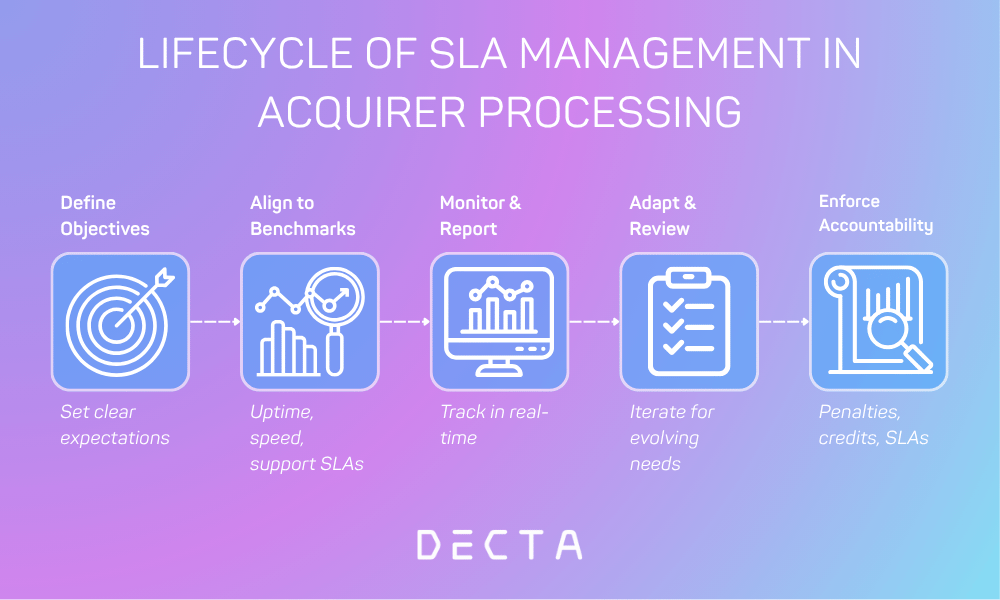
Define Clear Objectives: Assess each service for critical components and measurable standards and align SLA agreements with the strategic SLA alignment of acquirer and merchant.
Set Industry Benchmarks: Uptime (i.e., 99%), transaction processing speed (i.e., <2 hours credit to merchant), response time standards (i.e., <1 hour critical issues).
Incorporate SLA Accountability: Compensation clauses (refunds or credits) for SLA breaches and enforcement mechanisms (monetary penalties).
Monitor and Report: Performance metrics against SLA agreement must be tracked regularly generating transparent reporting for all involved parties.
Review and Adapt: SLA agreements reviewed periodically based on feedback/evolving business needs/SLA adaptability.
SLA agreement clarity is non-negotiable. Thus, empowered definitions of objectives and responsibility allow for a scalable approach.
Optimising Performance through SLA Monitoring
One of the best approaches to measuring SLA performance is through real-time performance monitoring. Monitoring should cover the same metrics the SLA defines, ideally through dashboards and automated alerts with thresholds set below the contractual limits, so teams can act before a breach occurs.
Performance metrics are driven through tangible and performance measures and by seeing how well Acquirers agree to adhere to those in real time through proactive deviation identification of performance issues.
The acquirer is more responsive through real-time performance tracking. The more performance insights acquired in the moment enables data-driven insights decision making to occur which allows for SLA optimization operations and service quality improvement before disruptions get out of hand.
For SLA adherence and performance maintenance, timeliness is everything. Thus, timely intervention can only occur when there is real-time awareness of discrepancies. This protects business operations while reassuring process peers that high quality standards are immediately sought and adhered to.
In conclusion, mastering SLA management is not just about meeting standards; it's about exceeding them. By focusing on key performance metrics, aligning with industry benchmarks, and ensuring reliability, you can transform your payment processing operations.
Talk to DECTA about your processing SLA
Get a dedicated contact who can walk you through uptime, support and reporting commitments for your acquiring programme.