What is Fraud Risk Management?

In this article, we will take a look at the common types of fraud businesses face, the key steps risk and compliance managers take when building an effective fraud risk management framework, and best practices to strengthen resilience against evolving threats.

October 22, 2025

Fraud risk management is the discipline of identifying, assessing, and mitigating the risk of fraudulent activities before they cause significant harm. In simple terms, it consists of proactive prevention, robust detection, and a clear incident response plan, held together by a written policy that says who is responsible for each of the three.

Types of business fraud infographic showing internal fraud, external fraud, financial statement fraud, customer fraud, vendor and procurement fraud, asset misappropriation, and bribery and corruption.

Types of Fraud Businesses Face

Being aware of the different types of fraud businesses may face means they can identify their vulnerabilities and implement fraud and risk management strategies.

Many organisations face different types of fraud, including:

Internal Fraud

Refers to in-house financial manipulation through activities like theft and embezzlement for personal gain.

External Fraud

Engaging in fraudulent activities perpetrated by external threats such as hackers, scammers, or counterfeiters. Examples include false invoicing and phishing attacks.

Financial Statement Fraud

This type of fraud means concealing the true health of a company by over- or understating a financial statement.

This can lead to business decisions being made under false pretences, and consequently, money loss for investors.

Customer Fraud

Customers engaging in illegitimate activities such a payment fraud (e.g. stolen credit or debit cards), return fraud, and false warranty claims.

For businesses that take payments online, this category splits into a few recognisable patterns.

Vendor Fraud/Procurement Fraud

Fraudulent activities committed by suppliers or in collusion with employees during the purchasing process, such as bid rigging, kickbacks, over-billing, or delivering inferior goods.

Asset Misappropriation

When an entrusted individual or entity within an organisation wrongfully uses company assets for personal advantage.

This can include misappropriation of cash, inventory theft, or misuse of company resources.

Bribery & Corruption

Refers to obtaining, offering or accepting something of value that holds power and influence over individuals who are in a position of integrity.

It can happen internally or through interaction with external sources (e.g., giving kickbacks to police).

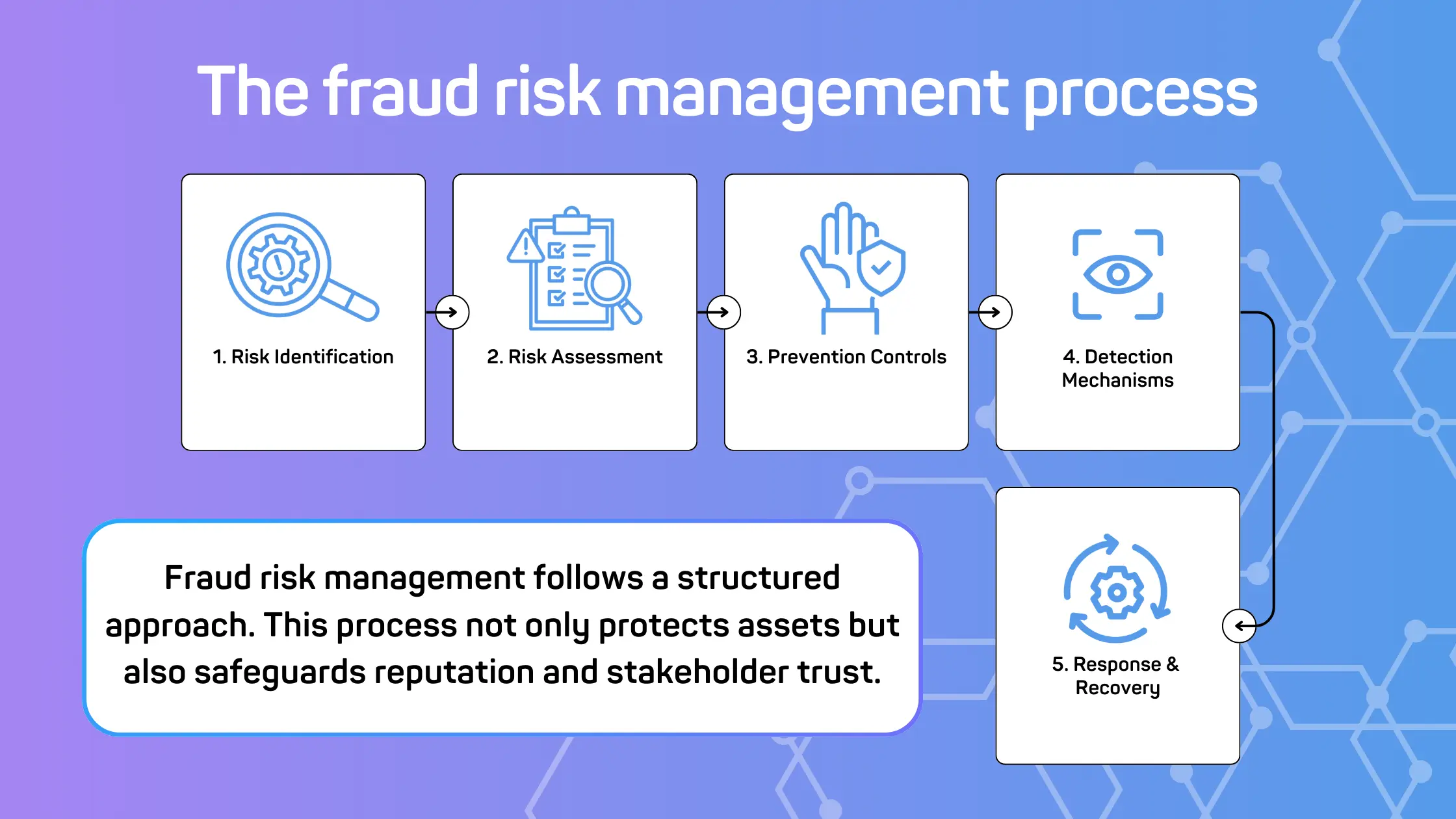
Fraud risk management process infographic showing five stages: risk identification, risk assessment, prevention controls, detection mechanisms, and response and recovery to protect assets, reputation, and stakeholder trust.

The Fraud Risk Management Process

The fraud risk management process works by following a structured approach.

This process not only protects assets but also safeguards reputation and stakeholder trust.

1. Risk Identification

The first step in the fraud and risk management process is pinpointing potential areas of weakness within the fraud landscape.

This involves conducting regular fraud risk assessments, reviewing business processes, analysing historical incidents, and considering both internal and external threats.

A useful lens here is the fraud triangle: pressure, opportunity, and rationalisation. Fraud tends to occur where a person is under financial or performance pressure, has an opportunity created by a weak control, and can justify the act to themselves.

You can rarely remove pressure or rationalisation, so managing fraud risk in practice means systematically closing the opportunity side.

2. Risk Assessment

Once fraud risks are identified, the next step is to evaluate them for the likelihood and potential impact of each fraud risk.

A comprehensive fraud risk assessment helps prioritise the most significant threats so that resources are allocated effectively.

This is also where you set a fraud risk appetite: the level of residual fraud loss the business accepts rather than spends more to prevent.

It matters because controls have a cost in money and in customer friction, and without a stated appetite every risk looks equally urgent.

3. Prevention Controls

A major component of the fraud risk management process is implementing preventive measures that reduce opportunities for fraud before it happens. This can include:

  • Segregation of duties
  • Approval chains to maintain policy compliance
  • Strict access controls
  • Vendor due diligence
  • Clear anti-fraud policies

4. Detection Mechanisms

Establish systems to uncover fraud quickly. Detection methods may include data analytics, whistleblower hotlines (which allow for anonymous reporting of suspicious activity), transaction and AI monitoring, and regular internal audits to flag anomalies.

Detection is a tuning exercise as much as a technology choice. Rules set too tightly generate false positives, blocking genuine customers and genuine payments, while rules set too loosely let fraud through.

Tracking the false positive rate alongside the fraud rate is what keeps a detection layer from quietly costing more revenue than the fraud it stops.

5. Response & Recovery

When fraud is detected, act immediately.

A well-defined fraud response plan should guide investigations, evidence collection, legal reporting, and strategies to recover financial losses.

Best Practices for Effective Fraud Risk Management

Implementing strong fraud risk management practices helps protect your organisation's assets, reputation, and long-term stability.

Here are the best practices to keep fraud at bay:

Conduct Regular Fraud Risk Assessments

Identify where your business is most vulnerable to fraud so you can prioritise specific areas, making fraud management and costs more effective.

Activities that will help include regular review processes, analysis of past incidents, and updating assessments at least annually, or whenever major changes occur.

Establish Clear Anti-Fraud Policies

Set written guidelines that define what fraud means in your business, outline reporting steps, and state the consequences.

Make sure all employees, vendors, and partners are aware of these rules.

Implement Strong Internal Controls

Limit opportunities for fraud with controls like segregation of duties, approval chains to maintain policy compliance, regular audits, and restricted access to sensitive data or funds.

Most organisations organise this using the three lines of defence model.

First line: the business teams that own and operate the controls day to day.

Second line: risk and compliance functions that set the policy and monitor it.

Third line: internal audit providing independent assurance.

Naming the lines matters because it removes the most common failure in fraud and risk management: everyone assuming fraud is somebody else's job.

Foster a Culture of Ethics & Transparency

Fostering an ethical culture comes from leading by example. Encouraging honesty, accountability, rewarding ethical behaviour, and creating an environment where employees feel safe raising concerns.

Setting a universal message at all levels of organisational culture, from senior management positions down to baseline employees, will employ a cohesive environment that works against fraud.

Leverage Technology for Fraud Detection

Utilise advanced technologies to detect fraud, such as artificial intelligence monitoring, data analytics, and machine learning, to give real-time alerts to highlight suspicious activity to halt it rapidly.

Provide Regular Employee Training

Train staff to recognise red flags, follow anti-fraud policies, and use reporting channels effectively.

Continuously Review & Improve Controls

As fraud tactics advance, so should your business's defences.

Audit and update your systems, policies, and training regularly to stay ahead of emerging threats.

Why Fraud Risk Management Matters for Risk and Compliance Managers

Here are key reasons why assessing potential risks and providing preventative measures is vital for businesses today.

Financially Stable & Protected

Fraudulent activity can result in material financial losses for a company.

By integrating a robust fraud risk management programme, you can help prevent fraud and mitigate potential losses.

Additionally, this highlights how cost-effective it is to implement precautionary steps and security measures.

It is better to invest in this earlier rather than the subsequent events of successful fraud (cost and resource-intensive for investigation and remediation).

Upholding a Reputation

Reputational damage can be concerning for any business.

If your business seems vulnerable to fraud, customers and stakeholders may feel reluctant to invest due to a lack of faith in the trustworthiness of the business.

This is why companies that invest in a strong fraud and risk management engine showcase commitment to ethical practices and establishing a secure business.

This element could provide a competitive advantage over other organisations.

Smooth Operations

Managing fraud risk effectively will reduce the potential risks of fraud.

Otherwise, business operations can be massively disrupted through events like loss of sensitive data or disrupted supply chains.

Through impactful fraud risk assessments and defensive strategies, a business's functions can continue to run smoothly.

Legal Compliance

Economic crime, like fraud, can result in infringement on legal compliance and regulatory requirements.

For businesses handling card payments in Europe, these obligations are concrete: PSD2 requires strong customer authentication on most electronic payments, PCI DSS compliance governs how cardholder data is stored and transmitted, and AML rules require you to know who your customers and merchants are before you transact with them.

This results in legal disruption, including regulatory investigations, civil lawsuits, criminal charges, contract termination or debarment, loss of licenses and certifications, and costly compliance obligations and penalties.

This can cause severe financial issues and damage long-term viability, which is why it is essential to introduce fraud risk management to every business.

Customer Data Protection

Businesses are responsible for protecting customer data to ensure compliance with data protection regulations.

Fraud poses a threat to the legitimacy of a business, customer trust, and legal obligations.

Strategic fraud risk management safeguards customer information and reduces the potential impact from data breaches caused by fraud.

Stay Ahead of Fraud with DECTA's Secure Payment Solutions

DECTA protects businesses from payment fraud with secure, end-to-end processing, issuing, and gateway services.

DECTA uses advanced fraud prevention tools, like EMV 3D Secure, real-time transaction monitoring, and strong multi-factor authentication.

EMV 3D Secure shifts liability for disputed card-not-present transactions to the issuer when the cardholder is authenticated, real-time monitoring scores each transaction before it is approved rather than after settlement, and multi-factor authentication blocks the stolen-credential attacks behind most account takeovers.

Together they stop card-not-present attacks, block suspicious payments, and keep authentication compliant with PSD2.

With DECTA, you can reduce fraud risk, safeguard revenue, and maintain customer trust.

Build Fraud Controls Into Your Payments

DECTA provides acquiring, issuing, and gateway services with fraud monitoring, dispute management, and compliance built into the same infrastructure.

Talk to DECTA