Building Payment Infrastructure For FinTech: Architecture, Security, and Regional Strategies
This article breaks down how to design and scale payment infrastructure for FinTech platforms, covering core stack components, architectural patterns, PCI-compliant data handling, and strategies for operating across regions. It focuses on practical trade-offs that affect reliability, security, and growth.
February 02, 2026
Payment infrastructure has moved from a backend concern to a core product and risk differentiator for FinTechs. Rising transaction volumes, real-time user expectations, stricter compliance regimes, and regional fragmentation are forcing teams to rethink how payments are architected, secured, and scaled.
This article provides a structured guide to building payment infrastructure that can evolve with regulatory pressure, withstand provider failures, and support expansion into new markets without constant rework.
What Does “Payment Infrastructure” Mean In A FinTech Context?
Payment infrastructure in FinTech refers to the foundational systems, networks, protocols, and technologies that enable secure, efficient electronic money transfers between parties, such as consumers, businesses, and financial institutions.
In practice, payment infrastructure links several layers of fintech infrastructure into one working flow. These layers handle authorisation, settlement, reconciliation, and reporting, often in real time. Fintech companies rely on this setup to keep payments stable as volume grows.
In the wider fintech ecosystem, payment infrastructure also acts as a connector. It ties your platform to banks, card schemes, wallets, and local payment rails. This connection lets you operate across regions without rebuilding your full stack each time.
Core Concepts Of A Contemporary FinTech Payments Stack
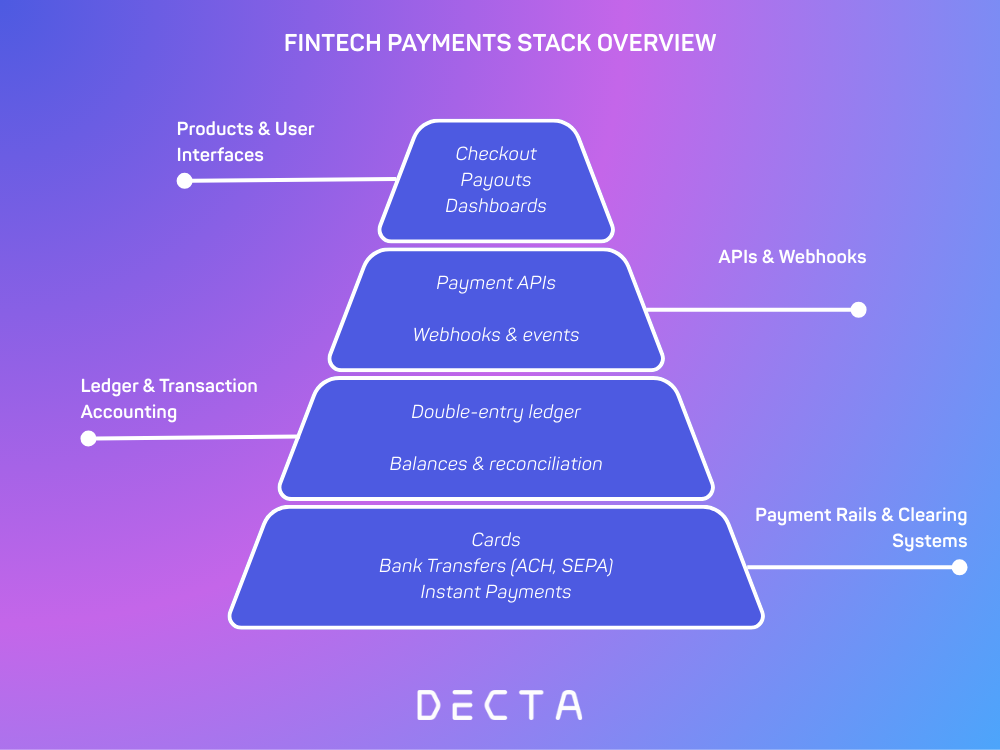
A contemporary FinTech payments stack relies on robust payment processing, an accurate ledger, and explicit integration points. Each layer must operate at scale, precision, and in real time without adding fragility.
Payment Rails And Local Clearing Systems
Payment rails and local clearing systems are the building blocks for payment processing over cards, ACH transfers, and instant payment systems.
You interact with card schemes like Visa and Mastercard, bank rails like ACH, SEPA or BACS, and instant payment systems like Faster Payments or RTP. Each has its own settlement windows, costs, and failure scenarios.
You can interface with local clearing systems via a processor or directly. Direct integration gives you more control over fees, data, and routing but costs more in terms of build and maintenance.
Abstraction layers are easier to work with and get you to market faster, but they have limitations around logic customisation and regional optimisations.
If you are doing cross-border payments, you also have to deal with FX, correspondent banks, and local regulations. These affect cost, settlement speed, and the user experience.
Ledger And Transaction Accounting Layer
The ledger and transaction accounting layer records all the money flows on your platform.
You use double-entry bookkeeping to ensure all transactions are balanced.
This keeps things honest and makes error detection easier.
You need to distinguish operational from accounting balances.
Operational balances capture any real-time activity such as pending authorisations or holds. Accounting balances are settled positions that can be audited for reporting.
A robust ledger supports:
Idempotent transaction posting
Immutable entries with timestamps
Reconciliation with payment processors and banks
APIs, Webhooks, And Integration Layers
APIs, webhooks, and integration layers provide an API-first FinTech stack and keep everything in sync.
You expose external APIs for payments, payouts, and account actions. Internal APIs manage risk checks, ledger updates, and routing decisions.
You make your APIs versioned, well-documented, and strict about input validation to protect the core systems and allow future changes.
You use webhooks to push real-time events like payment success, failure, chargebacks, etc. This updates downstream services without polling.
The integration layer covers retries, timeouts, and rate limiting for requests. These features help prevent cascading failures under peak load or when third parties are down.
Architecture Options For Building Payment Infrastructure
The architecture options for building your payment infrastructure define the implementation of features, risk, burden and rate of traffic you can scale to. They affect your rate of iteration, compliance burden, fault isolation and permit changes to be made to your flows without breaking your service.
Monolithic Vs. Modular Architectures In Early-Stage FinTechs
The use of monolithic and modular architectures in early-stage FinTechs defines the coupling of your payment logic, data and services. Monolithic system architectures couple your checkout, risk, ledger and settlement processes to a single application and database. You enjoy rapid feature implementation, easy testing and fewer requirements for deploying your code.
The downsides arise when you see a high volume of traffic or when your business rules are changing often. You have to ship significant changes for minor adjustments. Payment issues affect the functioning of unrelated processes. Compliance changes also necessitate sweeping changes to the code base.
A modular architecture breaks this monolith into domains, such as payments, ledgers and risk. You can start splitting read-only services or reporting into its own domain. You can then separate domains that need write access (like authorisation) by using stable APIs for each domain.
Factor
Time to launch
Change isolation
Long-term flexibility
Monolithic
Fast
Low
Limited
Modular
Moderate
High
Strong
Microservices Architecture For Scalable Payment Systems
Microservices architecture for payment systems operates with a distinct boundary for each service in your system. You typically have microservices for payments, user accounts, ledgers, fraud detection and reconciliation. Each microservice owns its own data and has a public API.
This architecture style allows you to horizontally scale the system for high loads during peak activity for a particular microservice. For instance, you can scale payment authorisations without needing to scale reporting tools used by the back office. You can also evolve and ship changes for a single microservice without redeploying your entire platform for a single team.
The downside of this higher operational complexity. You have to handle service discovery, monitoring and secure inter-service communication. Distributed transactions replace database joins, so you have to handle eventual consistency. In regulated use cases, this introduces the challenge of each microservice having audit logs and access controls.
Event-Driven And Asynchronous Processing Models
Event-driven and asynchronous processing models enable high-volume/high-concurrency payment flows. You decouple payment flows by publishing events such as payment authorised or settlement complete. These can be consumed by consumers of the events without blocking the payment process.
Asynchronous operations prevent cascading failures and reduce latency. You have to consider how consumers will safely handle duplicate events; hence, you should account for dead letter queues or idempotent keys to avoid double-charging your customer if something goes wrong.
Event-sourcing methodology stores changes as an immutable sequence of events, whereas traditional databases update rows in a mutable fashion. This is better for audit and replay capability, but less of a challenge for storage and querying. Traditional state mutation updates records, but is easier to operate, and you generally find both methodologies are used; events are created for the workflow, but a different read model is used for reporting.
Designing PCI-Compliant Token Storage For FinTechs
Designing PCI‑compliant token storage for FinTechs requires data minimisation, encryption and careful control of who sees payment data. You also have to manage audits, consent and ongoing compliance without adding friction to payment flows.
PCI DSS Requirements Every FinTech Must Understand
PCI DSS rules for token storage kick in as soon as you store, process or transmit card data. You need to minimise the cardholder data you hold and decide how long to keep it for. PCI DSS Requirement 3 says you cannot store sensitive authentication data, such as CVV, after authorisation.
You must make primary account numbers unreadable with encryption or tokenisation, or both. Everything you store must live in a PCI‑ compliant environment with access controls. You need to validate your PCI DSS compliance every year by passing assessments, scans and attestations. The method depends on your merchant level.
If you operate in the EU, you need to manage user consent for stored card data and allow it to be revoked. You must also detect breaches and report them within 72 hours.
Tokenisation Models For Card And Payment Data
Tokenisation techniques for card and payment data replace sensitive card numbers with non-sensitive tokens that hold no value outside your systems. Tokenisation limits your PCI scope and the impact of a breach.
Common tokenisation techniques include:
Gateway tokenisation, where a PCI Level 1 service provider stores cards.
Vault-based tokenisation, where a secure vault is used to issue tokens.
Format-preserving tokens, for legacy systems that need fixed-length tokens.
Choose a technique that stops raw card data hitting your back end. Client-side and direct-post tokenisation flows limit the exposure of card numbers at entry points. Tokens must be useless without access to the secure service that maps them.
Secure Storage, Access Controls, And Auditability
Secure storage, access controls and auditability underpin PCI‑compliant token storage operations. You need to store encryption keys separately to vaults and rotate them on a schedule.
Access controls must be least-privileged and use multi-factor authentication for operators. Avoid shared accounts and log all system access.
Auditability requires continuous logging, timestamps and tamper-proof logs. You need to preserve evidence for PCI assessments and partner queries. A well-designed audit trail helps with breach investigations and reporting to regulators without disrupting live payment processes.
Best Practices For Multiregional And Local Payment Methods
You increase conversion and the resilience of your system if you support local payments, local infrastructure, and isolate transactions from provider outages. Payment design is an integrated operation that involves user experience, compliance, and fault tolerance.
Considerations When Designing For Regional Payment Preferences
Designing for regional payment preferences means supporting payment methods that users already rely on in the region. UPI is the leading real-time bank payment method in India. Pix and Boleto matter in Brazil. iDEAL still has significance in the Netherlands. Treat them as the base layer.
Implement a unified payments interface to standardise all payment flows and use one API, so your product teams only have to implement features once instead of accommodating cards, wallets, and local bank payments. You will still design a front-end experience that adjusts to the region for language, currency, and field formatting.
Limit payment methods in each region to a handful of high-volume options. The more payment methods there are, the more friction there is and the longer checkouts take. Track drops, approvals, and retries for each method and use this data to improve methods over time.
Multi-Region Infrastructure And Data Residency
Multi-region infrastructure and data residency choices influence latency, reliability, and regulatory risk. Process payments as close to the user as possible to minimise authorisation delays and improve success rates. The latency of mobile checkouts can destroy conversions.
Use an active-active or active-passive structure for your multi-region infrastructure based on your size and risk exposure. Active-active improves speed and resilience but complicates data consistency and costs. Active-passive is easier to work with, but exposes your users for longer during failovers.
Comply with data residency rules per region. Tokenise payment details to avoid data residency issues when sharing data between regions. Treat logging, backup and storage the same as your data residency rules. Don’t create compliance loopholes.
Failover, Redundancy, And Provider Abstraction
Failover, redundancy, and provider abstraction keep the revenue engine going when payment providers misbehave or fail. Don’t couple any business logic to a single bank or gateway. Always abstract providers through your internal services with a predictable request and response structure.
Use smart routing to send requests to payment providers by region, method, cost, and real-time performance. For example, send UPI requests to the best-performing provider available. Use retry logic with backoff to avoid duplicate payments or overloading networks.
Always have at least two payment providers for high-traffic regions and methods. Test failover routes under real-world conditions, not just in theory. Watch latency, error rates, and timeouts so your system can switch routes without impacting users.
Security, Compliance, And Risk As First-Class Infrastructure Concerns
Security, compliance, and risk are essential topics in payment infrastructure, as they relate to your approach to building, operating, and scaling your FinTech core. You’ll want to secure payment data from collection to storage with encryption, tokenisation, and access control throughout this process.
Compliance governs how you operate your infrastructure and data. You’ll want to comply with PCI DSS for card payment, GDPR for personal data, and other local regulatory bodies. RegTech solutions can handle reporting, compliance control verification, and policy updates without interfering with your development cycles.
Identity checks help prevent fraud and regulatory non-compliance. Integrate KYC and identity checks at the start of the payment process to ensure users are legit. This process keeps your fraud and compliance issues low without complicating your audit procedure.
Fraud prevention and risk scoring should occur in real-time. Use transaction data, behavioural patterns, and device information to prevent fraudulent transactions before they settle. A solid fraud prevention strategy helps you avoid chargebacks and protects your customer base and merchants.
Security and risk management best practices can include:
Fraud detection with real-time alerts
Fraud prevention and risk scoring integration into payment flows
Identity checks and KYC processes as part of the user onboarding
Security audits and routine penetration testing for vulnerabilities
For continued compliance with security, you can implement rigorous management techniques. You’ll want to log access attempts and permission settings actively and perform routine audits. This process ensures compliance with the regulators and builds trust with auditors and partners.
Fraud Prevention And Risk Scoring Integration
Fraud prevention and risk scoring integration is a key layer of protection in your payment infrastructure for FinTech platforms. You’ll want to use systems that assess every transaction’s risk before funds are captured in real-time. This action helps to minimize risks while allowing smooth payment flows for all legitimate users.
You can combine rule-based checks with machine learning algorithms to score payment flows. Rule-based systems are ideal for known threats, such as blacklisted countries or velocity checks. Machine learning algorithms can discover new fraud attempts in the data on your transactions based on devices used and transaction history.
Signals to include in risk scoring can be:
Transaction data: Frequency, amounts, and times
Device data: Device used for the transaction
Location data: Where the transaction has come from
Network data: The network the payment source used
You can implement a risk score for all payments. You should let low-level payments through without any delay. Medium-level payments should go through with additional step-up checks, while high-risk payments should be flagged or denied.
Real-time processing is key to modern payment flows. Use AI systems to score all payments in a matter of milliseconds to avoid delays at checkout for users. This practice minimises instances of false-positive scores that annoy users.
You’ll want to structure your architecture to allow for integration without friction. You can use APIs and a microservices architecture for fraud detection models, allowing adjustments without introducing infrastructure updates that affect payments. This approach also helps when your platform scales and payment volumes increase.